Never miss whisky news, reviews, and new releases again.
Add Whisky Monkeys as a Google favoriteIn the Scottish Highlands sits a distillery whose whisky rings a bell for every enthusiast. Loch Lomond Distillery has been around for quite some time and boasts countless expressions to its name.
The story of the current Loch Lomond Distillery begins in 1965, but there are records of an earlier still house by the Scottish loch of the same name. As early as 1814, there may have been a Loch Lomond Distillery. Unfortunately, apart from a few sheets of paper, almost nothing is known about this whisky maker.
How Littlemill became the cradle of a titan
The Loch Lomond distillery whisky lovers know today reaches a little further back in time, though it didn’t yet carry the Loch Lomond name. In 1772, Littlemill Distillery was founded by George Buchanan. According to records, it was one of the first distilleries in Scotland to receive a license from King George III.
What Littlemill Distillery has to do with Loch Lomond becomes clear in 1960, when whisky is booming and new distilleries are springing up everywhere. That year, Duncan Thomas, owner of Littlemill Distillery, enters into a partnership with Barton Brands, a Chicago-based company.

De Loch Lomond Distillery aan de buitenkant
A miscalculation?
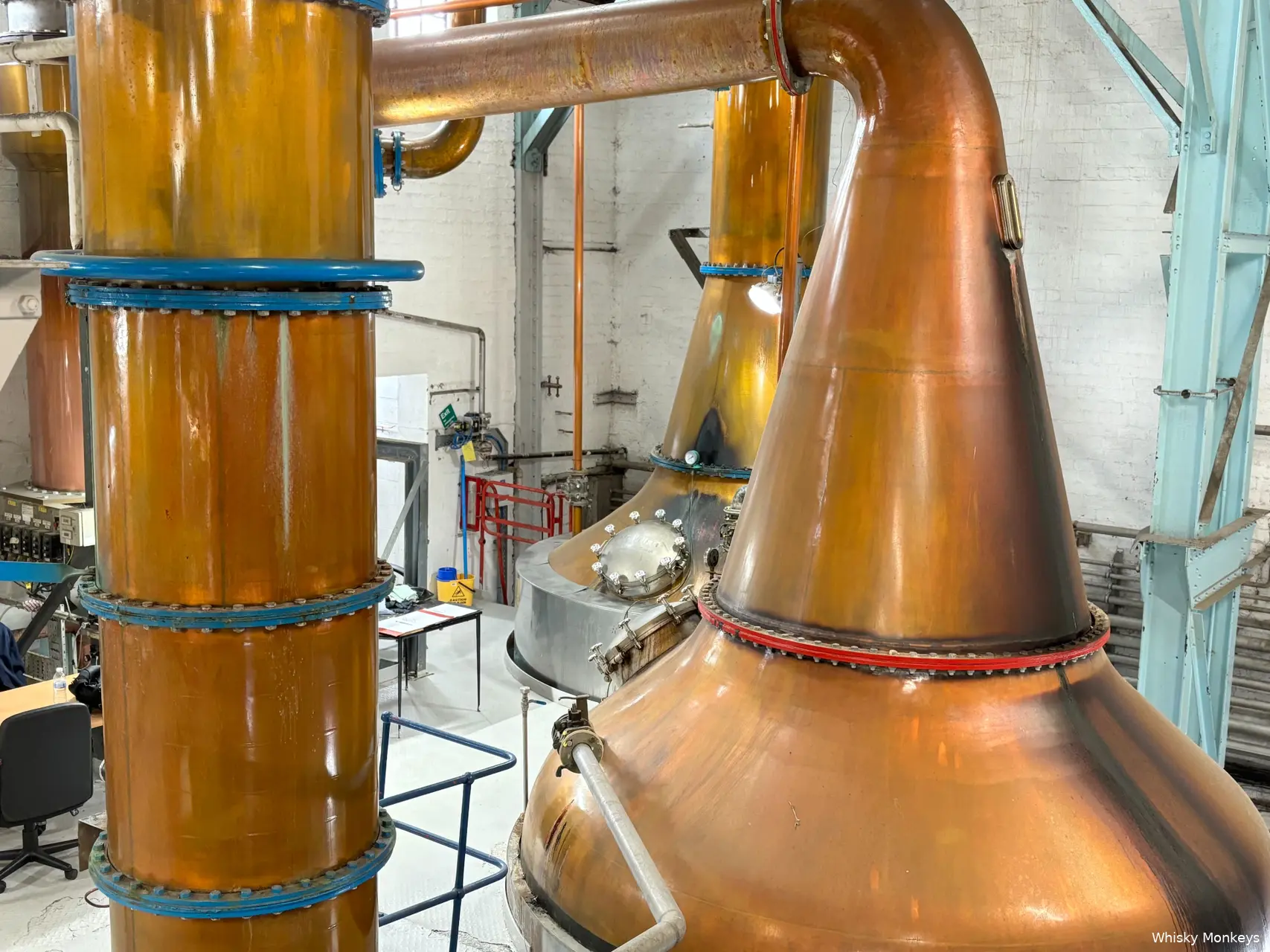
This leads to the construction of a new distillery on the site of the current one. It’s named after the nearby lake. Loch Lomond is born and begins producing whisky. The stills used are straight neck pot stills based on Littlemill’s designs.
Barton Brands envisions a golden future for the distillery and decides in 1971 to buy out the owner of Littlemill, taking full ownership of Loch Lomond. But the company’s vision doesn’t quite pan out. By 1980, the whisky boom has vanished like snow in the sun, and many Scottish distilleries are struggling.
The doors of Loch Lomond Distillery eventually close, and Barton Brands decides to sell the plant. In 1985, the Scottish distillery is sold to Inver House, and a year later a new owner, Glen Catrine Bonded Warehouse Ltd., steps in.
Mass production
Under the new owner, renovations begin. The two straight neck pot stills gain company. Two additional like-for-like pot stills are added to the distillery, doubling whisky production.
The plans are ambitious: in 1993, there’s another expansion. Loch Lomond adds a grain distillery and installs two column stills. Overnight, it becomes the only distillery in Scotland capable of producing both grain whisky and malt whisky.
Grain spirits are produced on a massive scale at the distillery, driven by three key pillars: speed, volume, and price. The spirit must be made quickly, in large quantities, and at minimal cost.
The output of Loch Lomond’s grain distillery is no small feat: it produces 20 million liters annually. This runs through several enormous washbacks, each with a capacity of up to 200,000 liters.
Even more capacity
As the grain distillery gathers steam, Glen Catrine decides to broaden its portfolio. The small, romantic Glen Scotia Distillery in Campbeltown is acquired.
And while Loch Lomond can now produce millions of liters of grain whisky, the malt side isn’t forgotten. Another expansion is planned. In 1998, a third type of still arrives at the malt distillery: a pair of traditional swan neck stills.
With the addition of this new still type and the use of different barley varieties, the distillery can suddenly create a wide spectrum of spirits. In total, no fewer than 13 distinct spirit styles can be produced, giving expressions like Inchmoan, Craiglodge, and Inchmurrin strikingly different flavor profiles.
Read also

A dispute with The Scotch Whisky Association
In 2008, Loch Lomond causes a stir. The Scotch Whisky Association (SWA) visits for a compliance check on Scotch whisky regulations. The inspector notices a coffey still operating continuously on site. Surprised by what he sees, he leaves the distillery.
Some time after his departure, a letter lands on the distillery’s doormat. It states that rules have been broken: single malt whisky may not come from a continuous process, but must be produced in batches. Column stills are also not permitted.
The result: the whisky from these stills may not be called single malt whisky, but must be labeled grain whisky.
Under one roof
In 2014, Loch Lomond changes hands one last time. The purchase price remains strictly confidential, but the new owner is clear: Loch Lomond Group. Its portfolio includes the historic Littlemill Distillery, Glen Scotia, The Glengarry, and the blended whisky brands Clansman and High Commissioner.
The arrival of the new owner doesn’t mark the end of the distillery’s many expansions. The site is being fitted with even more stills, pushing total output to 65 million bottles of whisky and other spirits per year.
To achieve that, countless casks are needed, which Loch Lomond stores across more than 25 warehouses. Before any spirit touches wood, every cask is inspected, repaired, charred, and properly labeled in the in-house cooperage. The distillery primarily uses ex-bourbon barrels, but you’ll also find finishes in ex-sherry and more exotic casks.
In-house cooperage
The cooperage is staffed by a team of seasoned coopers who hand-check every single cask. Andy Moore, one of the coopers, has been with the distillery for 53 years and can almost tell at a glance whether a cask will pass muster. Moore and his colleagues tend to each cask from start to finish.
Sometimes a cask needs to be planed or a small leak sealed. In other cases, entire staves are replaced, with the cask taken apart like a giant 3D puzzle. Moore takes it all in stride and knows exactly what needs to be done.
Finally, the casks are freshly toasted, sometimes with flames leaping from the wood. It’s a craft to be proud of and not something you’d expect to find within the vast industrial walls of Loch Lomond.
Plans for the future
Although the distillery in the Scottish Highlands doesn’t have a visitor center, we recently paid it a visit. We learned that there’s currently a garden center right in the middle of the grounds, where Loch Lomond actually hopes to create a visitor experience.
loading
POPULAR NEWS
Whisky Names Explained: Octomore
Bowmore Brings Back a Devilish Whisky After More Than 10 Years (and Two Old Casks Take Center Stage)
Glenfiddich, Ardbeg, and Jameson are joined by new names on the 2026 Best Whiskies list

This Japanese whisky is almost too beautiful to open

From Rat to Dragon and Goat: These Whisky Bottles Form a Remarkable Collection
Japanese Oak Lends a Distinctive Twist to This Belgian Whisky (Review)
Belgian Distillery Gone: Old Caperdonich Stills Up for Auction
This Highlander is Glenmorangies oldest whisky ever
5 Indian whiskies that taste like liquid gold

Dutch Investor Unmasks a Massive Whisky Scam After a Failed Investment
LATEST COMMENTS
- Thank you for the compliment. I really appreciate it.M0nkey31-08-2026
- I enjoyed reading the different approaches to building a whisky collection. Whether you collect by region, style, or limited releases, discovering new brands keeps the hobby interesting. Soorahi is another premium whisky worth considering for collectors looking to explore the evolving world of quality whiskies.dinesh04-08-2026
- There is no distillery equipment there and also no licences to produce or sell alcohol.TRC19-12-2025
- Hi Yvonne, Thank you for your response and for sharing the video. Unfortunately, the evidence you referred to consists only of two people talking about the whisky, without any explanation or identification. We have not spoken to the individuals in the video ourselves, nor can we verify who they are. We describe it as a Chinese whisky because it is released by a Chinese distillery. As you mentioned, the distillery has chosen to label the product as “pure malt” instead of “Chinese whisky.” Based on that, we do not believe they are doing anything illegal.M0nkey16-11-2025
- So - you have the proof......where's your write up?Yvonne16-11-2025
- You are absolutely right. Luckily that doesn't matter for the taste of the whisky. Have you tried it yet?M0nkey05-11-2025
- Guess what? Finland is not part of Scandinavia.Gray105-11-2025
- Throw in the towel? You mean restructure to compete and win in a challenging industry environment.WestwardFounder21-10-2025
- There is nothing legally to prevent the English whisky GI from coming into force, it complies with all the relevant laws and the single malt definition follows the precedent of Welsh whisky and US whiskyChefBear15-10-2025
- Three emails sent (two with videos, linked to a Google Drive Share). 1. The original video. 2. The video with subtitles as it was shared on YouTube 3. Screen grab of the YouTube channel where the video was blocked due to Pernod Ricard lobbying. The story was covered on Drinks Intel at the time - link here - https://drinks-intel.com/subscriber-news/pernod-ricards-the-chuan-pure-malt-whisky-not-sourced-solely-from-china-global-drinks-intel-exclusive/Yvonne10-10-2025
Loading