Never miss whisky news, reviews, and new releases again.
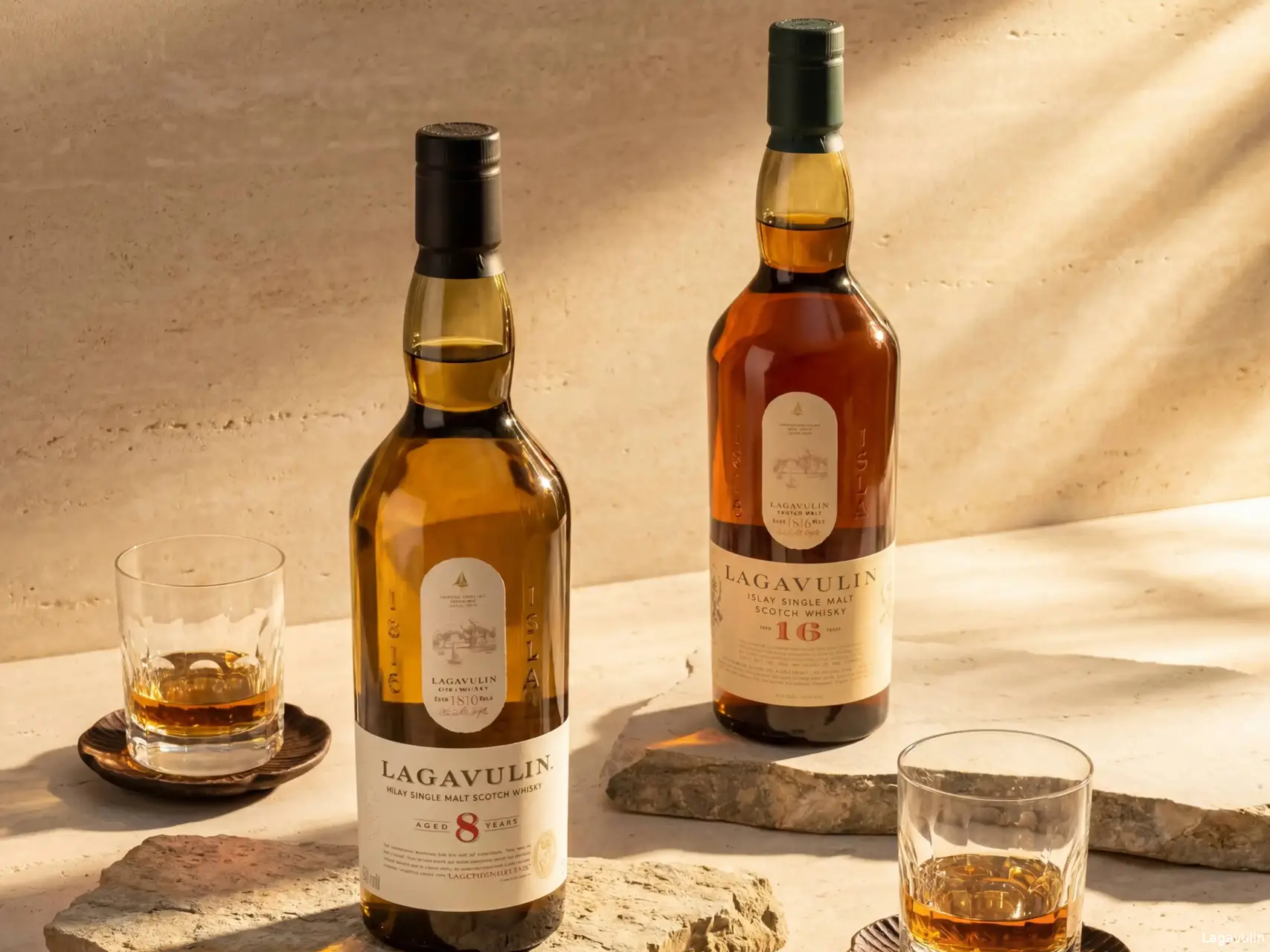
Add Whisky Monkeys as a Google favoriteWelcome to a brand-new feature on Whisky Monkeys: the Whisky Battle. In each battle, we put two whiskies side by side. They might share a similar age, maturation style or place of origin. Kicking things off are two Lagavulin whiskies that pair smoke with very different flavours.
In Whisky Battle, we pit two well-known whiskies against each other and explore what makes each one special. This time, it’s Lagavulin 8 Year Old and Lagavulin 16 Year Old. At first glance, they have plenty in common, but they turn out to be surprisingly different. What makes this comparison especially interesting is how smoke, maturation and alcohol strength come together in each whisky.
Two Islay brothers
When you think of Lagavulin, you might picture smoke, the Scottish whisky island of Islay and, of course, Lagavulin 16 Year Old. It’s one of the best-known whiskies in the Scottish distillery’s range. In 1988, it featured in the Classic Malts of Scotland collection, where Lagavulin represented Islay.
Since then, the 16-year-old has become a classic, known around the world for its blend of peat smoke, maritime influences and sweeter notes.
Lagavulin 8 is much younger. It was only released in 2016. The interesting thing is that it was never intended to be a permanent fixture.
The inspiration for Lagavulin 8 goes all the way back to the 19th century. In 1886, renowned whisky writer Alfred Barnard visited the distillery as part of his tour of Scotland’s whisky makers. There, he tasted an eight-year-old Lagavulin and was hugely impressed by its quality. More than 130 years later, the distillery decided to put that age back in the spotlight with a special edition.
It proved to be a hit. Whisky lovers embraced Lagavulin 8 so enthusiastically that the distillery added it to its core range in 2017.
Why Lagavulin 8 is stronger than Lagavulin 16
Let’s take a closer look at the differences between these two Islay whiskies. One of the most striking differences is right there on the label.
Lagavulin 8 is bottled at 48% ABV, while Lagavulin 16 comes in at 43%. So the whisky that’s twice as old has the lower alcohol strength. That doesn’t automatically make the younger one better or smokier. The ABV simply tells you how strong the whisky is when it goes into the bottle.
In Lagavulin 8, that higher strength contributes to a bold character. The whisky is known for its upfront peat smoke, citrus freshness and peppery notes. The 16-year-old reveals another side of the distillery, with dried fruit, sweetness and wood taking their place alongside the smoke.

The difference in flavour between Lagavulin 8 and 16 goes beyond smoke
Peat smoke is a defining feature of many whiskies from the island, and Lagavulin is no exception. But not all smoky whiskies taste the same.
Lagavulin 8 brings together ashy smoke, salinity, citrus and pepper. It’s often described as lively and direct, with fresh, spicy notes taking centre stage.
Lagavulin 16 has a different profile. Here, peat smoke meets richer notes of dried fruit, sweetness and wood, creating a more rounded whisky. Herman van der Meij aptly compares it to liquorice root: when you chew it, the sweetness comes first, followed by a dry note—much like Lagavulin 16.
Longer maturation doesn’t automatically mean a whisky is less smoky. How we experience the smoke depends on the other flavours around it. In the eight-year-old, it stands out alongside citrus and spice. In the 16-year-old, that same smoky style is joined by sweeter, fruitier notes.
What does eight extra years of maturation do to Lagavulin?
The difference between eight and sixteen years sounds substantial. But you can’t simply think of Lagavulin 16 as an eight-year-old single malt that spent a little longer in the cask. A great deal happens in the cask, and it has a major influence on the whisky’s flavour.
Lagavulin 16 has had sixteen years to develop. That helps create the rich combination of smoke, fruit and sweetness the whisky is known for. Lagavulin 8 has matured for less time, allowing its lively, smoky and spicy qualities to come through in a different way.
So it’s not simply a matter of young versus old. These are two distinct expressions of Lagavulin’s character.

Which Lagavulin is right for fans of smoky whisky?
Lagavulin 8 is particularly appealing to those who enjoy a bold combination of smoke, citrus, salinity and spice. At 48% ABV, it’s also bottled at a higher strength.
Lagavulin 16 is better suited to those who prefer a richer blend of flavours. Smoke remains front and centre, complemented by dried fruit, sweeter notes and oak.
Price can also be a factor. The 8-year-old is generally less expensive than the 16-year-old. But ultimately, the biggest difference isn’t the price tag—it’s the character you’re looking for.
Lagavulin 8 vs Lagavulin 16: which whisky wins the battle?
Put the two Lagavulin whiskies side by side, and you’ll discover that Lagavulin reveals two quite different sides of its distillery.
The 8-year-old stands out for its higher ABV, fresh smokiness and spicy character. The 16-year-old, by contrast, offers a richer flavour profile, bringing together peat smoke, dried fruit and sweetness.
So the winner isn’t nearly as obvious as you might expect. Fans of bold, upfront peat smoke will give Lagavulin 8 top marks. Those who prefer a fuller, rounder and fruitier character will probably want to see a Lagavulin 16 in their Glencairn glass.
Above all, this Whisky Battle shows just how different two whiskies from the same distillery can be—even when they both share Islay’s unmistakable smoky style.
Want to explore more of our features? You can do so here
Made possible by Diageo. Nix18.
loading
POPULAR NEWS
Whisky Names Explained: Octomore
Bowmore Brings Back a Devilish Whisky After More Than 10 Years (and Two Old Casks Take Center Stage)
Glenfiddich, Ardbeg, and Jameson are joined by new names on the 2026 Best Whiskies list
This Japanese whisky is almost too beautiful to open
From Rat to Dragon and Goat: These Whisky Bottles Form a Remarkable Collection
Japanese Oak Lends a Distinctive Twist to This Belgian Whisky (Review)
Belgian Distillery Gone: Old Caperdonich Stills Up for Auction
This Highlander is Glenmorangies oldest whisky ever
5 Indian whiskies that taste like liquid gold
Dutch Investor Unmasks a Massive Whisky Scam After a Failed Investment
LATEST COMMENTS
- Thank you for the compliment. I really appreciate it.M0nkey31-08-2026
- I enjoyed reading the different approaches to building a whisky collection. Whether you collect by region, style, or limited releases, discovering new brands keeps the hobby interesting. Soorahi is another premium whisky worth considering for collectors looking to explore the evolving world of quality whiskies.dinesh04-08-2026
- There is no distillery equipment there and also no licences to produce or sell alcohol.TRC19-12-2025
- Hi Yvonne, Thank you for your response and for sharing the video. Unfortunately, the evidence you referred to consists only of two people talking about the whisky, without any explanation or identification. We have not spoken to the individuals in the video ourselves, nor can we verify who they are. We describe it as a Chinese whisky because it is released by a Chinese distillery. As you mentioned, the distillery has chosen to label the product as “pure malt” instead of “Chinese whisky.” Based on that, we do not believe they are doing anything illegal.M0nkey16-11-2025
- So - you have the proof......where's your write up?Yvonne16-11-2025
- You are absolutely right. Luckily that doesn't matter for the taste of the whisky. Have you tried it yet?M0nkey05-11-2025
- Guess what? Finland is not part of Scandinavia.Gray105-11-2025
- Throw in the towel? You mean restructure to compete and win in a challenging industry environment.WestwardFounder21-10-2025
- There is nothing legally to prevent the English whisky GI from coming into force, it complies with all the relevant laws and the single malt definition follows the precedent of Welsh whisky and US whiskyChefBear15-10-2025
- Three emails sent (two with videos, linked to a Google Drive Share). 1. The original video. 2. The video with subtitles as it was shared on YouTube 3. Screen grab of the YouTube channel where the video was blocked due to Pernod Ricard lobbying. The story was covered on Drinks Intel at the time - link here - https://drinks-intel.com/subscriber-news/pernod-ricards-the-chuan-pure-malt-whisky-not-sourced-solely-from-china-global-drinks-intel-exclusive/Yvonne10-10-2025
Loading