Never miss whisky news, reviews, and new releases again.
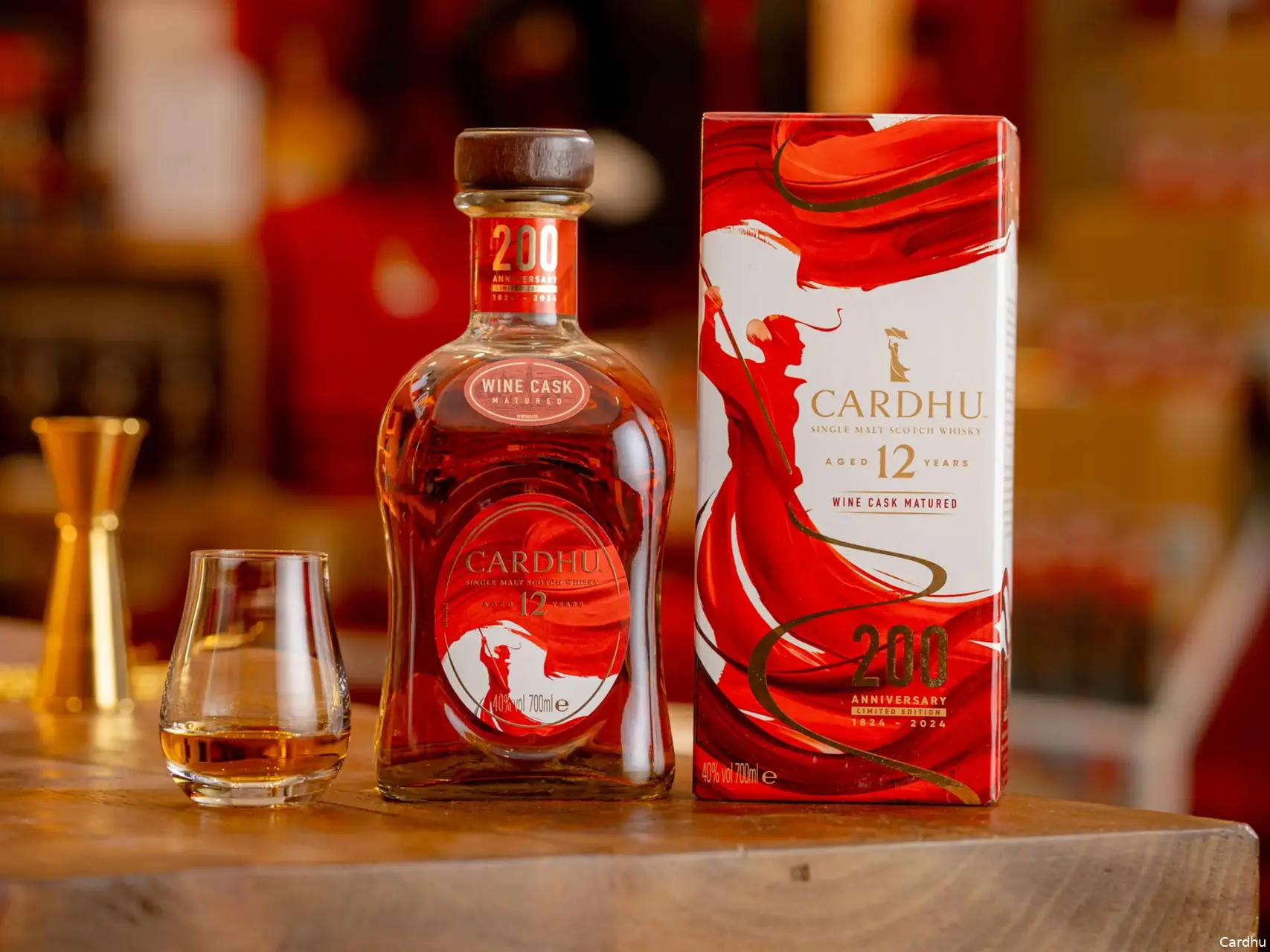
Add Whisky Monkeys as a Google favoriteIf you’ve ever seen a bottle of Cardhu whisky, a black rock probably isn’t the first thing that comes to mind. Yet that’s exactly what the name of this well-known Speyside whisky refers to. But there’s more to the name than a bit of Scottish landscape. The distillery itself went by a different name for many years, and its history is quite remarkable.
In this edition of Whisky Names Explained, we explore the story behind Cardhu. To do so, we’ll travel back to a Scottish farm where whisky was once distilled illegally.
What does the name Cardhu mean?
Cardhu comes from Scottish Gaelic and is generally translated as “black rock.” The name is associated with the words Carn Dubh, which refer to a dark rock or rocky hill.
The name is closely tied to the landscape where the whisky is made. Cardhu is located near Knockando, in the heart of Scotland’s Speyside region. The area is known for its rolling hills, lush green countryside and, of course, its many whisky distilleries.
But the distillery hasn’t always been called Cardhu. Look through old records, and you’ll find another name: Cardow. That was the name of the farm where it all began, and for many years it was also the distillery’s official name. The whisky, however, was being sold as Cardhu before the distillery itself officially adopted the name.
Read also
From Cardow to Cardhu
To understand how Cardhu came about, we need to go back to the early 19th century. John Cumming and his wife, Helen, were making whisky on their farm in Speyside. At first, they did so without a licence—a far from unusual practice in Scotland at the time.
Helen Cumming, in particular, played a striking role in the story. According to legend, she warned other illicit distillers whenever tax inspectors were nearby. She is even said to have used a red flag to alert them. In 1824, the family was granted an official licence to produce whisky, making Cardow a legal distillery.
Over time, the name Cardhu became increasingly associated with the whisky itself. Rather than keep the anglicised spelling Cardow, the distillery chose a name closer to its Scottish Gaelic roots. It wasn’t until the 20th century that Cardhu also became the distillery’s official name.
A whisky with a remarkable history
There’s something else that makes Cardhu stand out. While Scotland’s whisky industry was long dominated by men, women played a particularly important role at this distillery.
After Helen Cumming, it was Elizabeth Cumming who took the distillery forward. Under her leadership, a new, larger distillery was built in 1886. The old stills were sold to William Grant, who used them when founding Glenfiddich. Cardhu therefore has a remarkable connection to another famous name in the world of Scotch whisky.
In 1893, the distillery was sold to John Walker & Sons. Its whisky would go on to play an important part in Johnnie Walker blends. Today, Cardhu remains a well-known Speyside single malt, with established bottlings including Cardhu 12 Year Old.
So when you pour yourself a glass of Cardhu today, you’re enjoying more than a whisky from one of Scotland’s best-known whisky regions. Behind the name lies a story of an old farm, illicit whisky-making and two women who helped shape the distillery’s history.
loading
POPULAR NEWS
Whisky Names Explained: Octomore
Bowmore Brings Back a Devilish Whisky After More Than 10 Years (and Two Old Casks Take Center Stage)
Glenfiddich, Ardbeg, and Jameson are joined by new names on the 2026 Best Whiskies list
This Japanese whisky is almost too beautiful to open
From Rat to Dragon and Goat: These Whisky Bottles Form a Remarkable Collection
Japanese Oak Lends a Distinctive Twist to This Belgian Whisky (Review)
Belgian Distillery Gone: Old Caperdonich Stills Up for Auction

This Highlander is Glenmorangies oldest whisky ever
5 Indian whiskies that taste like liquid gold

Dutch Investor Unmasks a Massive Whisky Scam After a Failed Investment
LATEST COMMENTS
- Thank you for the compliment. I really appreciate it.M0nkey31-08-2026
- I enjoyed reading the different approaches to building a whisky collection. Whether you collect by region, style, or limited releases, discovering new brands keeps the hobby interesting. Soorahi is another premium whisky worth considering for collectors looking to explore the evolving world of quality whiskies.dinesh04-08-2026
- There is no distillery equipment there and also no licences to produce or sell alcohol.TRC19-12-2025
- Hi Yvonne, Thank you for your response and for sharing the video. Unfortunately, the evidence you referred to consists only of two people talking about the whisky, without any explanation or identification. We have not spoken to the individuals in the video ourselves, nor can we verify who they are. We describe it as a Chinese whisky because it is released by a Chinese distillery. As you mentioned, the distillery has chosen to label the product as “pure malt” instead of “Chinese whisky.” Based on that, we do not believe they are doing anything illegal.M0nkey16-11-2025
- So - you have the proof......where's your write up?Yvonne16-11-2025
- You are absolutely right. Luckily that doesn't matter for the taste of the whisky. Have you tried it yet?M0nkey05-11-2025
- Guess what? Finland is not part of Scandinavia.Gray105-11-2025
- Throw in the towel? You mean restructure to compete and win in a challenging industry environment.WestwardFounder21-10-2025
- There is nothing legally to prevent the English whisky GI from coming into force, it complies with all the relevant laws and the single malt definition follows the precedent of Welsh whisky and US whiskyChefBear15-10-2025
- Three emails sent (two with videos, linked to a Google Drive Share). 1. The original video. 2. The video with subtitles as it was shared on YouTube 3. Screen grab of the YouTube channel where the video was blocked due to Pernod Ricard lobbying. The story was covered on Drinks Intel at the time - link here - https://drinks-intel.com/subscriber-news/pernod-ricards-the-chuan-pure-malt-whisky-not-sourced-solely-from-china-global-drinks-intel-exclusive/Yvonne10-10-2025
Loading