Never miss whisky news, reviews, and new releases again.
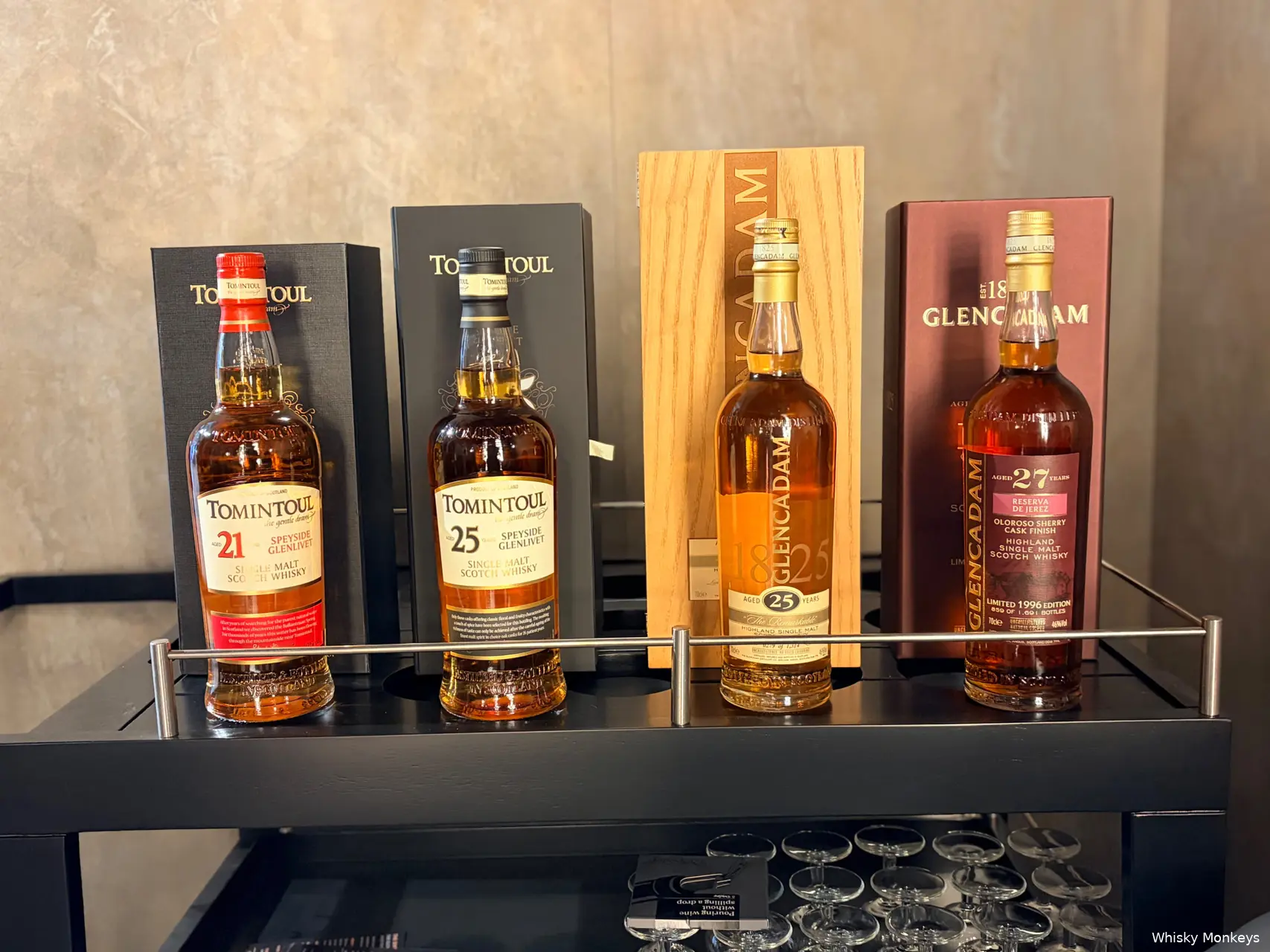
Add Whisky Monkeys as a Google favoriteSometimes there isn’t a regular tasting on the agenda, but a little journey where you get to sample nearly 100 years of whisky. A select group of whisky lovers, including us, is invited for a tasting that does exactly that: four remarkable drams from two distilleries, and above all, inspiring and surprising stories about the water of life.
Led by Iain Forteath, Master Blender and Global Brand Ambassador at Angus Dundee Distillers, we’re treated to an hour-long masterclass on the whiskies of Tomintoul and Glencadam. The plan originally called for three special drams, but Forteath pulled a fourth from his bag as a surprise.
Right from the start, Forteath promises a few surprises in nose and palate. This is no tasting of standard bottles you see everywhere. The spotlight today is firmly on Tomintoul and Glencadam, two Angus Dundee brands with distinctly different personalities. While Tomintoul proudly calls itself The Gentle Dram, Glencadam shows a brighter, more tropical side of Scotch whisky.
A gentle opening with Tomintoul 21
The first dram sets the tone straight away. Tomintoul 21 is described as a whisky with real presence, despite its 40% ABV. That might sound modest, but in the glass it shows surprising grip and body.
According to the explanation, that’s largely down to the wood. Bourbon casks lend the whisky a certain bite, a chewiness, without ever turning aggressive. That’s exactly Tomintoul’s style: whisky with character, yet always on the gentle side. It’s aptly described as a warm embrace from an old friend: comforting, rounded, and friendly, but never dull.
On the nose and palate, fruity notes take the lead: think red berries, honey, and spice. There’s also a comparison to longer bourbon-cask maturation, where classic notes like vanilla, crème brûlée, and stewed apples evolve into deeper aromas over time. After about 18 years, that profile begins to caramelize, bringing almost sherry-like tones: honey, toffee, and candied fruit.
Tomintoul 21 stays mostly on the fruit-forward side. While the 25-year-old Tomintoul later shows more chocolate and nuttiness, this dram revolves around red fruit, honey, and warm spices. Smooth, spicy, and full, with no hard edges.

Tomintoul 25: the whisky that unexpectedly made world headlines
Next up is Tomintoul 25, a whisky with a great story. According to Iain, this dram was once dubbed the best whisky in the world by Forbes after it rose to the top of a U.S. spirits ranking. The funny part? The team doesn’t even know. A friend sends a message asking, “Is this you?” Only then do they realize how highly the whisky has been rated.
That anecdote fits Tomintoul perfectly. It’s not a brand that shouts from the rooftops. There are no bombastic campaigns or heavy-handed branding. The whisky does the talking. And with the 25, it does so effortlessly.
This whisky also comes from bourbon casks, but its character clearly differs from the 21. Here we’re talking a mix of bourbon barrels and hogsheads. Those hogsheads bring a different wood profile and add depth. The result is a dram that’s less red-fruit driven and leans more into chocolate, honey, cream, and nuts.
On the palate, the balance really stands out. The whisky has a lovely, full texture and a soft, convivial finish. Not harsh or overly powerful. Just beautifully integrated. That word comes up repeatedly during the tasting: balance. For older Tomintoul, it’s a core principle. It isn’t about maximum alcohol punch or maximum oak; it’s about a whisky where everything falls into place.
Tomintoul 25 feels like the older, more mature sibling of the 21. Where the 21 leans on red fruit, honey, and spice, the 25 brings more chocolate, nuts, and creamy richness. Still gentle, still quintessentially Tomintoul, but with greater depth and a long, warming aftertaste.

The magic of maturing in the mountains
Between sips, we delve into the role of maturation location. Tomintoul sits high and remote, deep in the mountains. According to Iain, there are far more sheep than people in the area, with virtually no pollution or traffic. That creates ideal conditions for maturation: cool, humid, and calm.
High humidity affects the angel’s share. At Tomintoul, it averages around 1.8%, we’re told. In some warehouses the loss stays low, while younger spirit and certain storage methods can push losses higher, especially in the early years when casks are filled at higher strength. After a few years, it evens out.
It’s details like these that add depth to a tasting. You don’t just taste what’s in the glass, you also understand better why a whisky tastes the way it does. Tomintoul’s softness doesn’t come out of nowhere. It’s in the spirit, in the casks, and in the environment where the whisky rests for years.
From Speyside to the Highlands with Glencadam 25
After Tomintoul, the tasting continues virtually to Glencadam. A very different distillery with a very different signature. Where Tomintoul was built in 1965 and has largely worked the same way ever since, Glencadam is truly old. The distillery is over 200 years old and still has a quirky, compact layout. Not a sleek, open space made for Instagram, but a distillery built to make whisky.
Glencadam’s character is described as fresh, bright, and fruity. Tropical fruit, citrus, orchard fruit, and a lively tension in the spirit. That shines beautifully in the Glencadam 25.
According to Ian, this whisky is all about the distillery core itself. Not about a blender trying to build something grand, but about Glencadam’s DNA. And that DNA is strikingly fresh for a 25-year-old whisky. In the glass, peach, apricot, and fresh stone fruit come to the fore. Haribo peach candies even come to mind for us.
The longer the whisky sits in the glass, the more layers unfold. Beyond the fresh fruit come leathery tones, a pleasant touch of mustiness, bakery spices, and gentle floral accents. Marshmallow gets mentioned too. By nosing with your mouth open, as a blender would, Ian says more subtle tones emerge: chamomile, flowers, nuttiness, and extra softness.
The Glencadam 25 is anything but a hefty old whisky. It’s lively rather than heavy. A dram that proves age doesn’t have to mean heavy or dusty. It still smells and tastes fresh, yet carries the complexity you’d expect from 25 years of maturation.

Glencadam 27 Reserva de Jerez: not a sherry bomb, but certainly grand
To close things out, something special appears: a Glencadam 27 that hasn’t yet launched in the Netherlands. According to Ian, only a small allocation is available, and he’s brought the whisky as a bonus treat for those present.
In the session, this whisky is described as a dram that stretches the idea of finishing. It involves long maturation, with a substantial period in bourbon followed by years in Oloroso sherry wood. The official release, Glencadam 1996 27 Years Old Reserva de Jerez, is bottled at 46% ABV, non-chill filtered, natural colour, and limited to 1,691 bottles.
What stands out most: this isn’t a blunt sherry bomb. Glencadam isn’t a heavy spirit by nature, and they don’t want to bury that. The whisky is rich and sherry-led, yet remains elegant. Notes of pecan pie, maple syrup, toast, Oloroso, fruit, and gentle spice drift by. It’s even called almost cognac-like: subtle, deep, and slightly refined.
On the palate it’s sweet and spicy, but not overly thick. The sherry is clearly present, yet the Glencadam spirit holds its own. That’s what makes the whisky compelling. It shows that an old sherry finish doesn’t have to end in pure raisins, chocolate, and brute force. It can also be restrained, layered, and exciting.
98 years of whisky in 30 minutes
At the end of the session, it’s time to take stock. In roughly 30 minutes, nearly 100 years of whisky pass by: Tomintoul 21, Tomintoul 25, Glencadam 25, and Glencadam 27. That’s far too quick for drams like these. Some glasses deserve 20 minutes on their own, especially when there’s so much happening.
Yet that very pace makes the tasting special. It’s a compact journey through two distilleries, two styles, and four whiskies that each show something different. Tomintoul brings warmth, softness, honey, spice, chocolate, and balance. Glencadam brings freshness, tropical fruit, peach, citrus, elegance, and old Highland depth.
Favorites at the table vary. The Tomintoul 25 impresses with its fruitiness, chocolate, and creamy balance. The Glencadam 27 draws attention for its rarity and refined sherry character. But that’s exactly the beauty of this tasting: there is no wrong answer. And that’s the magic of whisky—it’s personal, and everyone finds something to savor.
Want to read more of our event reports? You can on this page.
loading
POPULAR NEWS
Next year’s exclusive Johnnie Walker whisky is already on sale

The 10 whisky brands connoisseurs admire most
You’ll never drink whisky the same way after trying these chocolate pairings

Scottish community distillery sounds the alarm as whisky industry downturn bites
UK government shuts down whisky company over the sale of non-existent casks

Laphroaig honors its savior with an extraordinarily old and rare whisky
This rare whisky combines Belgian spirit with Japanese craftsmanship
Breaking: English whisky wins historic protection

Why Bruichladdich’s Master Blender Wants Islay in Every Drop of Whisky
These Zodiac Signs Are Getting Their Own Whisky in the Grand Finale of a Celebrated Series
LATEST COMMENTS
- Thank you for the compliment. I really appreciate it.M0nkey31-08-2026
- I enjoyed reading the different approaches to building a whisky collection. Whether you collect by region, style, or limited releases, discovering new brands keeps the hobby interesting. Soorahi is another premium whisky worth considering for collectors looking to explore the evolving world of quality whiskies.dinesh04-08-2026
- There is no distillery equipment there and also no licences to produce or sell alcohol.TRC19-12-2025
- Hi Yvonne, Thank you for your response and for sharing the video. Unfortunately, the evidence you referred to consists only of two people talking about the whisky, without any explanation or identification. We have not spoken to the individuals in the video ourselves, nor can we verify who they are. We describe it as a Chinese whisky because it is released by a Chinese distillery. As you mentioned, the distillery has chosen to label the product as “pure malt” instead of “Chinese whisky.” Based on that, we do not believe they are doing anything illegal.M0nkey16-11-2025
- So - you have the proof......where's your write up?Yvonne16-11-2025
- You are absolutely right. Luckily that doesn't matter for the taste of the whisky. Have you tried it yet?M0nkey05-11-2025
- Guess what? Finland is not part of Scandinavia.Gray105-11-2025
- Throw in the towel? You mean restructure to compete and win in a challenging industry environment.WestwardFounder21-10-2025
- There is nothing legally to prevent the English whisky GI from coming into force, it complies with all the relevant laws and the single malt definition follows the precedent of Welsh whisky and US whiskyChefBear15-10-2025
- Three emails sent (two with videos, linked to a Google Drive Share). 1. The original video. 2. The video with subtitles as it was shared on YouTube 3. Screen grab of the YouTube channel where the video was blocked due to Pernod Ricard lobbying. The story was covered on Drinks Intel at the time - link here - https://drinks-intel.com/subscriber-news/pernod-ricards-the-chuan-pure-malt-whisky-not-sourced-solely-from-china-global-drinks-intel-exclusive/Yvonne10-10-2025
Loading