Never miss whisky news, reviews, and new releases again.
Add Whisky Monkeys as a Google favoriteWhisky is shaped by many elements: the water, the soil where the grain grows, and the wood of the casks. At the Yamazakura distillery, the wind also plays a leading role. In this Distillery Thursday we head to the Land of the Rising Sun and dive into the rich history of this Japanese distillery, which stretches back several centuries.
The beginning of a grand adventure
The story of the Yamazakura Distillery takes us far, far back in time. In 1710, a small brewery was founded south of Lake Inawashiro in Japan. This brewery made sasa, Japanese sake, following a traditional Yamaguchi family recipe.
In 1742, the Sasanokawa Shuzo brewery was set to move. At its new location, the brewery continued small-scale sake production under the leadership of Tetsui Monetmo and grew in popularity. This momentum led to the founding of Yamaguchi Sake Brewery Co. in 1920 and the establishment of Yamazakura Sake Brewing Limited Partnership Company in 1932.
Not long after, they received a license to produce synthetic sake, much needed due to a rice shortage in Japan. After all, rice is a key ingredient in the national drink. Western culture was increasingly influencing Japan, sparking the idea to produce whisky alongside sake.

Western influence leads to the first whisky
It wasn’t until 1946 that the Sasanokawa Shuzo brewery received a license to produce whisky. In the years that followed, they also obtained a license for shochu and, under a Western-style license, were allowed to distill other spirits such as gin and vodka. There was still no whisky on the market yet, even though they were permitted to distill it.
Meanwhile, the company moved to a new site in Fukushima, where in the 1970s it finally released its first whisky from cask: Cherry EX. This blended whisky was bottled at 40% ABV and sold in 500-milliliter bottles.
An unbreakable bond forged
The whisky quickly became one of the better-known Japanese bottlings, alongside releases from Mars and Toa. Then another crisis struck, not rice this time, but whisky. Or more accurately, a collapse in demand. Several distilleries were forced to close, and Japanese whisky fell into a deep slump.
The Hanyu distillery of Ichiro Akuto was among the casualties. Tetsueo Yamaguchi, then director of Sasanokawa, decided to help. He arranged for 400 casks from his friend’s warehouse to be stored in one of Sasanokawa’s facilities until 2008.
In the meantime, Akuto was able to establish a new distillery, one you likely know: Chichibu. And those casks Yamaguchi safeguarded? They became the bottles you might recognize as Ichiro’s Malt. It forged an unbreakable bond and put a spotlight on Sasanokawa. More importantly, it inspired Yamaguchi to set up a distillery of his own.

Asaka, the distillery of the wind
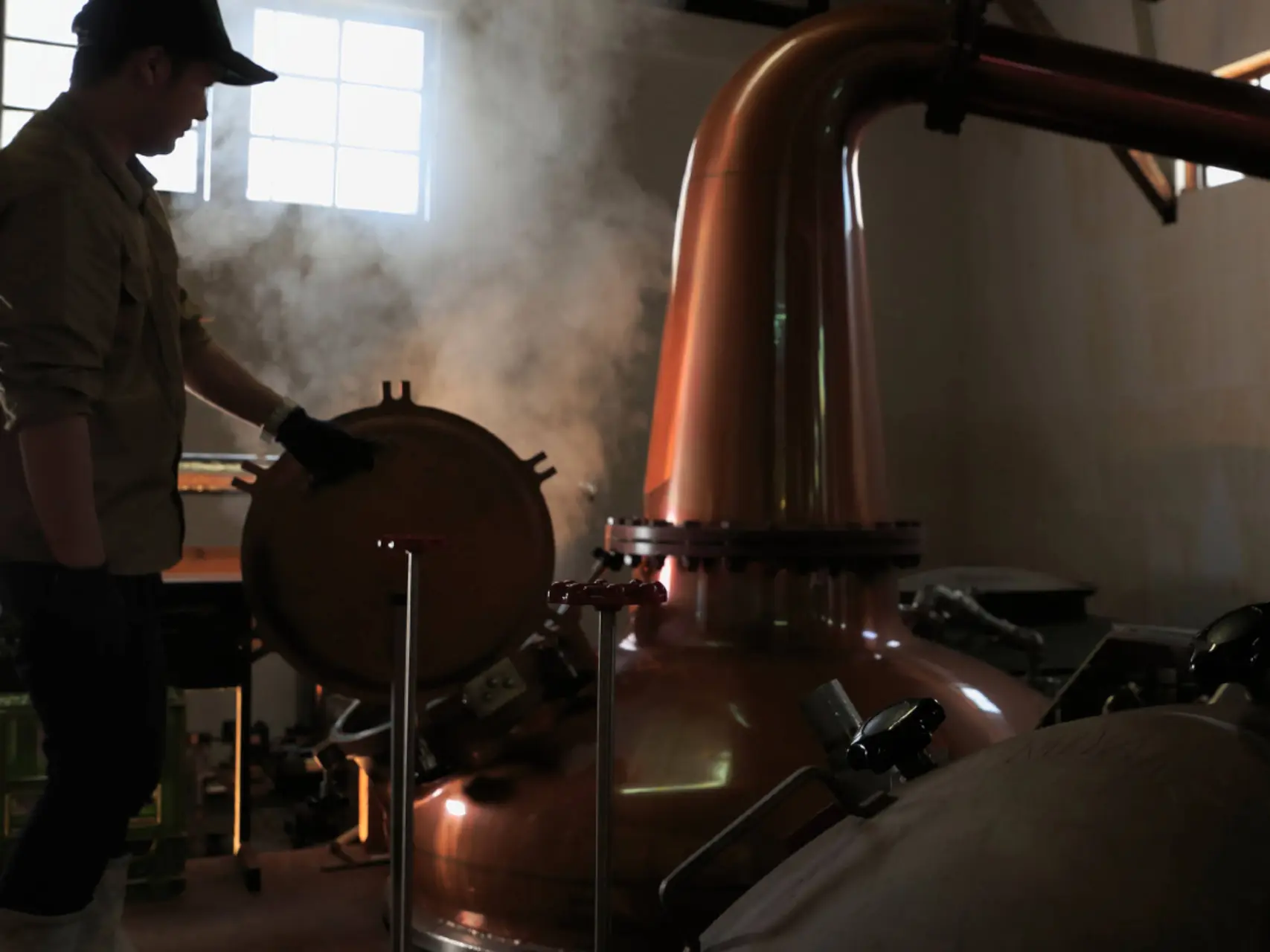
In 2016, on the 250th anniversary of Sasanokawa Shuzo, the moment arrived: the Asaka Distillery opened its doors just a stone’s throw from the brewery. The 390-square-meter building had previously served as a storage facility for Sasanokawa sake, but was completely transformed into a distillery.
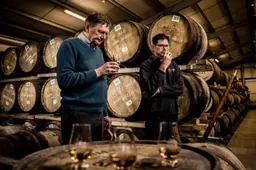
Behind two enormous black doors lies the Japanese distillery, equipped with two pot stills and a wash tun, plus on-site cask storage. The water of life is distilled here just 150 days a year by a team of four. They craft Japan’s liquid elixir in a traditional, artisanal way, with regular training from the team at the Chichibu distillery.
The magic of cherry blossom, a volcano, and the wind
The whisky distilled at Asaka is known as Yamazakura: a name that nods to the distillery’s home. The first half, “Yama,” means mountain and points to nearby Mount Bandai, a stratovolcano. The second half, “zakura,” pays tribute to the cherry blossoms of the Tohoku region.
Yamazakura whisky is made with meltwater from the mountains, remarkably pure and ideal for distilling. To draw more flavor into the spirit, distillation is maintained at a minimum of 70 degrees, after which the corn-based distillate matures in ex-bourbon casks from the Heaven Hill distillery, as well as sherry and mizunara casks.
One crucial element in maturation comes from an unexpected source: Bandai Oroshi, the regional wind, helps accelerate aging and infuses the whisky with deeper aromas.

Versatile Japanese whisky
The magic of these elements comes together in a range of expressions released over the years. The most recent include Yamazakura Blended Malt, Yamazakura Peated Blended Malt, and the flagship Yamazakura Asaka Single Malt. In 2022, the distillery even took home the title of “World’s Best Blended Malt” at the World Whiskies Awards for its blended.
For Yamazakura blended whisky, the team uses, among others, Asaka whisky distilled from corn. This dram carries no age statement but matured for at least three years in ex-bourbon, ex-Oloroso, and ex-Pedro Ximénez casks. The result is a soft, fruity whisky with notes of pear, caramel, and vanilla.
The peated version of the Japanese blend follows a similar path, but brings a touch of smoke that will appeal to lovers of peat. Asaka Distillery’s signature whisky is the eponymous single malt: Yamazakura Asaka. Released in limited quantities, it offers aromas of malt and citrus on the nose, followed by floral tones, lemon, and vanilla on the palate.
Whichever whisky from the Asaka distillery you pour, they all share one thing: they’re born of centuries of knowledge, craft, friendship, and passion.
Photos: Asaka Distillery
loading
POPULAR NEWS
Whisky Names Explained: Octomore
Bowmore Brings Back a Devilish Whisky After More Than 10 Years (and Two Old Casks Take Center Stage)
Glenfiddich, Ardbeg, and Jameson are joined by new names on the 2026 Best Whiskies list
This Japanese whisky is almost too beautiful to open
From Rat to Dragon and Goat: These Whisky Bottles Form a Remarkable Collection
Japanese Oak Lends a Distinctive Twist to This Belgian Whisky (Review)
Belgian Distillery Gone: Old Caperdonich Stills Up for Auction
This Highlander is Glenmorangies oldest whisky ever
5 Indian whiskies that taste like liquid gold
Dutch Investor Unmasks a Massive Whisky Scam After a Failed Investment
LATEST COMMENTS
- Thank you for the compliment. I really appreciate it.M0nkey31-08-2026
- I enjoyed reading the different approaches to building a whisky collection. Whether you collect by region, style, or limited releases, discovering new brands keeps the hobby interesting. Soorahi is another premium whisky worth considering for collectors looking to explore the evolving world of quality whiskies.dinesh04-08-2026
- There is no distillery equipment there and also no licences to produce or sell alcohol.TRC19-12-2025
- Hi Yvonne, Thank you for your response and for sharing the video. Unfortunately, the evidence you referred to consists only of two people talking about the whisky, without any explanation or identification. We have not spoken to the individuals in the video ourselves, nor can we verify who they are. We describe it as a Chinese whisky because it is released by a Chinese distillery. As you mentioned, the distillery has chosen to label the product as “pure malt” instead of “Chinese whisky.” Based on that, we do not believe they are doing anything illegal.M0nkey16-11-2025
- So - you have the proof......where's your write up?Yvonne16-11-2025
- You are absolutely right. Luckily that doesn't matter for the taste of the whisky. Have you tried it yet?M0nkey05-11-2025
- Guess what? Finland is not part of Scandinavia.Gray105-11-2025
- Throw in the towel? You mean restructure to compete and win in a challenging industry environment.WestwardFounder21-10-2025
- There is nothing legally to prevent the English whisky GI from coming into force, it complies with all the relevant laws and the single malt definition follows the precedent of Welsh whisky and US whiskyChefBear15-10-2025
- Three emails sent (two with videos, linked to a Google Drive Share). 1. The original video. 2. The video with subtitles as it was shared on YouTube 3. Screen grab of the YouTube channel where the video was blocked due to Pernod Ricard lobbying. The story was covered on Drinks Intel at the time - link here - https://drinks-intel.com/subscriber-news/pernod-ricards-the-chuan-pure-malt-whisky-not-sourced-solely-from-china-global-drinks-intel-exclusive/Yvonne10-10-2025
Loading