Never miss whisky news, reviews, and new releases again.
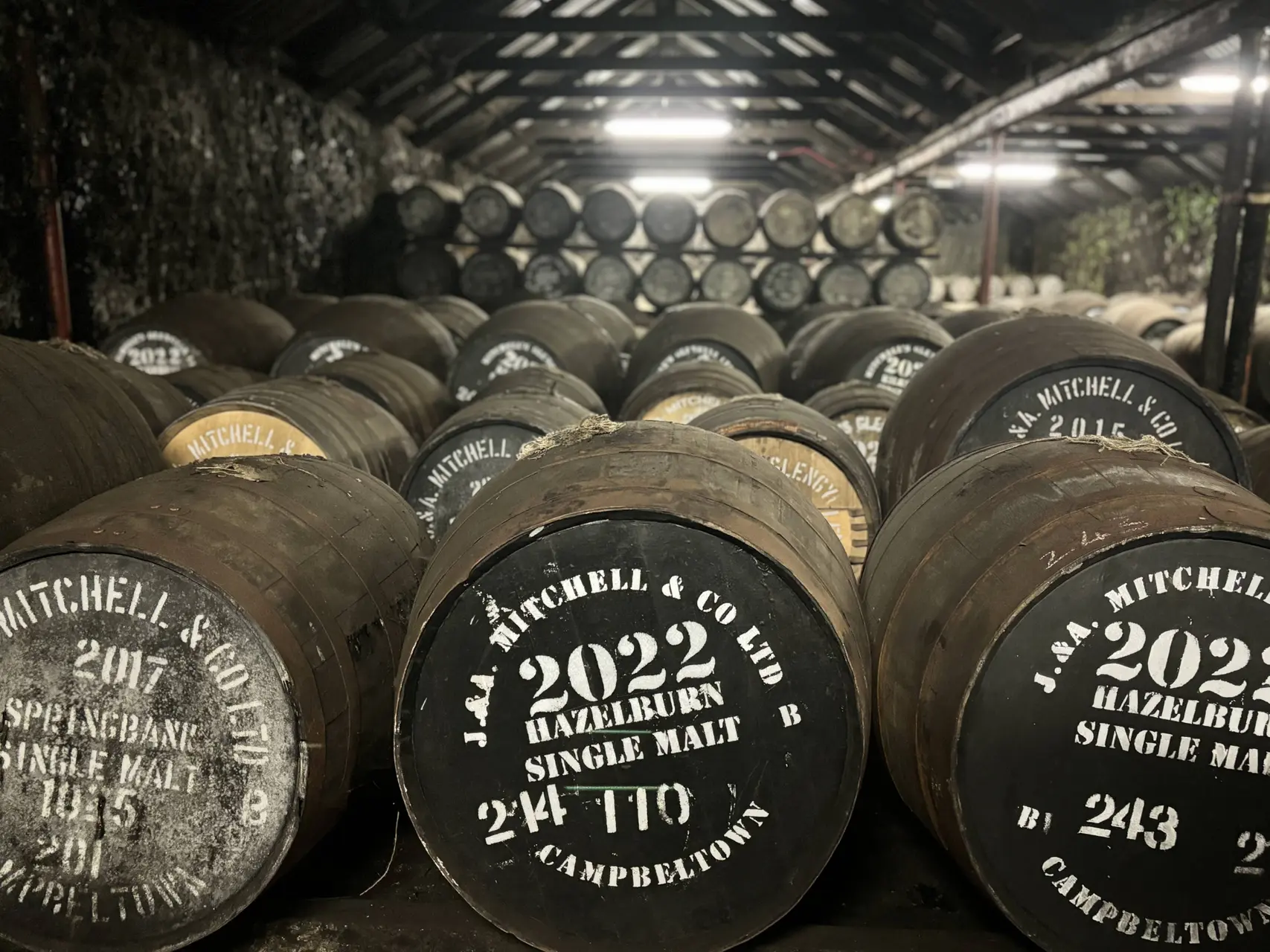
Add Whisky Monkeys as a Google favoriteAnyone seeing a bottle of Hazelburn might easily assume that there is a Hazelburn Distillery somewhere in Campbeltown. Yet that has not been the case for more than 100 years. The whisky is now made at Springbank, but the name takes us back to a vanished distillery that was once one of the largest in Campbeltown.
And anyone delving into Hazelburn’s history will encounter something even more remarkable. The distillery was not always in the same place, and whisky may have been made under this name before Hazelburn was officially established as a distillery: in secret, most likely.
It is time to travel back to Campbeltown in the 18th and 19th centuries.
Where does the name Hazelburn come from?
Today’s Hazelburn is one of three different single malt whiskies made at Springbank Distillery. Alongside Springbank itself, the distillery also produces the heavily peated Longrow and the unpeated Hazelburn. To trace the origins of that final name, we need to return to the former Hazelburn Distillery in Campbeltown.
Its history, however, is not entirely clear. Hazelburn is generally regarded as a distillery dating from 1825. There are indications, though, that its story reaches further back. A 1922 description of Hazelburn even refers to documents kept at the distillery at the time. Among them was a licence from 1796, and there were reportedly accounting records dating back to 1794.
That does not automatically mean that the Hazelburn Distillery as we would later know it already existed in 1794. It does show, however, that distilling had taken place much earlier on or around the site associated with Hazelburn.
Illegal whisky production was hardly unusual in this area during the 18th and early 19th centuries. The same 1922 description even claims that as many as 32 distilleries were operating in the area in 1725. Many of them would have borne little resemblance to the large distilleries that later emerged in Campbeltown.
Hazelburn was originally located elsewhere
This makes the story even more complicated. The Hazelburn Distillery that eventually grew into one of Campbeltown’s largest producers was probably not on the original site.
Historic Environment Scotland states that Hazelburn was originally located on Longrow, with its malt barns in what is now Longrow South. Precisely where the first distillery stood is difficult to establish today. Historical reconstructions place it somewhere at the southern end of Longrow, in the part of Campbeltown where several distilleries stood close together. That changed in the 19th century.
In 1836, a much larger Hazelburn Distillery was built at Millknowe. Historic Environment Scotland dates parts of the surviving complex to that year and records that a large new distillery was built on the site around 1840.
It therefore seems highly likely that Hazelburn genuinely changed location during this period. The older site on Longrow was replaced by a much larger complex on Millknowe Road, between Millknowe Road and Lochend Street.
Hazelburn grew into a huge distillery
Whisky writer Alfred Barnard visited Campbeltown in 1885 during his famous tour of the distilleries of the United Kingdom. His account provides an exceptionally detailed picture of Hazelburn at the height of its existence. Barnard also wrote that Hazelburn had been rebuilt in 1836. The complex covered approximately 3 acres and was particularly impressive by Campbeltown standards. While many distilleries were built around a single courtyard, Hazelburn had two.
There were five maltings, three kilns and nine washbacks, each holding 6,000 gallons. The whisky then passed through three copper stills. The wash still was especially noteworthy. With a capacity of 7,000 gallons, Barnard described it as the largest wash still in Campbeltown at the time. Alongside it stood two smaller stills, each holding 1,800 gallons.
Hazelburn’s storage capacity also illustrates just how large the distillery was. It had nine warehouses. When Barnard visited, they held around 302,000 gallons of whisky. According to the manager, the warehouses could together accommodate as much as 500,000 gallons. In 1885, Hazelburn produced 192,000 gallons of whisky. Barnard put its maximum annual capacity at 250,000 gallons. Twenty-two people worked there, and given the scale of production, three Inland Revenue officers were also stationed on site.
At the time, the whisky was simply sold as Campbeltown Malt, but it would have been Hazelburn.

From Hazelburn’s demise to its return at Springbank
An account from 1922 shows that Hazelburn, by then owned by Mackie & Co., had been extensively modernised. The distillery even had a laboratory where glass mash vessels, fermentation flasks and a small still were used to experiment with ways of improving the production process.
Hazelburn would not benefit from these advances for long. Campbeltown’s whisky industry fell on hard times, and Hazelburn was forced to close—according to some sources in 1925, and according to Historic Environment Scotland in 1929. Parts of the former complex can still be found on Millknowe Road, with several buildings and walls protected as historic heritage.
Yet the name Hazelburn did not disappear forever. In 1997, Springbank began producing a new whisky under this historic name, without attempting to recreate the original whisky. Hazelburn was given its own character alongside Springbank and Longrow: completely unpeated and triple-distilled using all three of Springbank’s stills.
The result is a light, delicate and creamy whisky, with Hazelburn 10 Year Old now serving as its principal bottling. The whisky does not come from the original Hazelburn Distillery, but it keeps alive the memory of a distillery that was once one of Campbeltown’s largest.
Want to discover more Whisky Names Explained stories? You’ll find them here
loading
POPULAR NEWS
Next year’s exclusive Johnnie Walker whisky is already on sale
You’ll never drink whisky the same way after trying these chocolate pairings
Whisky Names Explained: Octomore
This rare whisky combines Belgian spirit with Japanese craftsmanship
Glenfiddich, Ardbeg, and Jameson are joined by new names on the 2026 Best Whiskies list
The hidden numbers on your whisky bottle reveal more than you think
World famous Dutch whisky pioneer celebrates 50 years with a mythological whisky series
This whisky cask is nearly empty, but the spirit left inside could become legendary
Japanese Oak Lends a Distinctive Twist to This Belgian Whisky (Review)
Belgian distillery unveils Brussels’ first whisky, but you’ll need to act fast if you want one
LATEST COMMENTS
- Thank you for the compliment. I really appreciate it.M0nkey31-08-2026
- I enjoyed reading the different approaches to building a whisky collection. Whether you collect by region, style, or limited releases, discovering new brands keeps the hobby interesting. Soorahi is another premium whisky worth considering for collectors looking to explore the evolving world of quality whiskies.dinesh04-08-2026
- There is no distillery equipment there and also no licences to produce or sell alcohol.TRC19-12-2025
- Hi Yvonne, Thank you for your response and for sharing the video. Unfortunately, the evidence you referred to consists only of two people talking about the whisky, without any explanation or identification. We have not spoken to the individuals in the video ourselves, nor can we verify who they are. We describe it as a Chinese whisky because it is released by a Chinese distillery. As you mentioned, the distillery has chosen to label the product as “pure malt” instead of “Chinese whisky.” Based on that, we do not believe they are doing anything illegal.M0nkey16-11-2025
- So - you have the proof......where's your write up?Yvonne16-11-2025
- You are absolutely right. Luckily that doesn't matter for the taste of the whisky. Have you tried it yet?M0nkey05-11-2025
- Guess what? Finland is not part of Scandinavia.Gray105-11-2025
- Throw in the towel? You mean restructure to compete and win in a challenging industry environment.WestwardFounder21-10-2025
- There is nothing legally to prevent the English whisky GI from coming into force, it complies with all the relevant laws and the single malt definition follows the precedent of Welsh whisky and US whiskyChefBear15-10-2025
- Three emails sent (two with videos, linked to a Google Drive Share). 1. The original video. 2. The video with subtitles as it was shared on YouTube 3. Screen grab of the YouTube channel where the video was blocked due to Pernod Ricard lobbying. The story was covered on Drinks Intel at the time - link here - https://drinks-intel.com/subscriber-news/pernod-ricards-the-chuan-pure-malt-whisky-not-sourced-solely-from-china-global-drinks-intel-exclusive/Yvonne10-10-2025
Loading