Never miss whisky news, reviews, and new releases again.
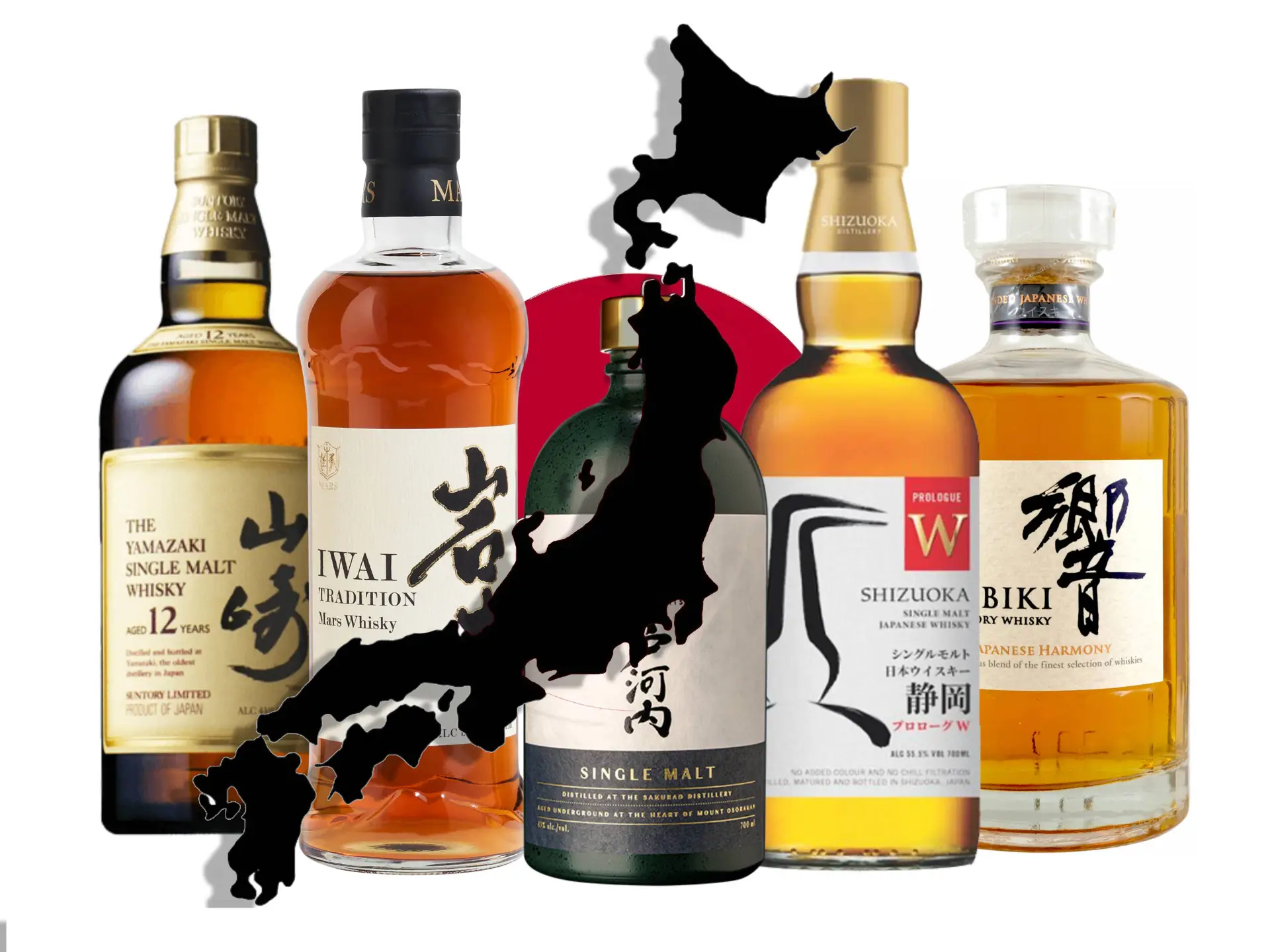
Add Whisky Monkeys as a Google favoriteWe can easily divide Scotch whisky into the well-known whisky regions. But what about whisky from the Land of the Rising Sun? These are the Japanese whisky regions, along with a general guide to the flavor profiles of the divine spirit they produce.
While Scotland has clearly defined whisky regions, Japanese whiskies can also be grouped by region. These aren’t regions like the Highlands, Lowlands, or Speyside, but rather prefectures or areas where various distilleries work day in, day out on their own interpretation of the water of life.
In this feature, we start in the north of Japan and gradually make our way south.
Note: We describe a typical flavor profile for each whisky region, but individual whiskies may vary. Just like in Scotland, Japanese distillers experiment with grain types, fermentation, cask selection, and maturation.

The Hokkaido whisky region
The first Japanese whisky region we’ll cover is Hokkaido: a large island in the north of Japan, roughly the size of Austria. Like Islay, Hokkaido is known for its wild, changeable weather. Summers tend to be very warm and winters cold. In the west of the island, icy air sweeps in and the landscape is often blanketed in thick snow.
Hokkaido is home to several distilleries, including the Hokkaido Akkeshi Distillery, Kamui, and the Yoichi Distillery. Nikka opened its very first whisky distillery on the island with Yoichi.
Hokkaido whiskies are typically characterized by a blend of spicy notes with a touch of peat influence.
The Tohoku whisky region
A little further south lies the Tohoku region. Its name reflects its position in the country and loosely translates to “Northeast.” While slightly smaller than Hokkaido, there’s plenty of whisky to discover here.
Nikka operates the Miyagikyo Distillery in this region. You’ll also find Kinryu Yuza, Sasanokawa, and the Asaka Distillery in the area. Tohoku is known for its fertile soil and pristine water.
That shows in the whisky: the prevailing style is smooth and fruity, thanks in part to locally grown grain. The milder climate also leads to a very different maturation profile than in Hokkaido.

The Kanto whisky region
Kanto may well be Japan’s best-known whisky region, it’s where Tokyo is located. In whisky terms, it’s home turf for distilleries like Chichibu and Hanyu.
Whiskies from Kanto often lean toward greater complexity, with a broad spectrum of flavor profiles.
The Chubu whisky region
Next up is the Chubu region. Many whisky lovers who’ve sampled Japanese whisky will have encountered bottles from here. Chubu is home to some of Japan’s oldest distilleries, including Fuji Gotemba, Shizuoka, Hakushu, Karuizawa, Shinsu (Mars Whisky), and The Chita.
With this heritage, many whiskies from the region are crafted in a traditional style. You can taste it and see it in the price tag. A number of brands release premium expressions that command top prices in our market.
Whisky from the Kansai region
Another region hosting famous names is Kansai. How about The Yamazaki Distillery or Akashi Distillery?
This region lies in the southern part of Japan’s largest island. Expressions from Kansai vary in character, but typically feature floral notes alongside fruit, with an overall gentle, approachable style.

The Chugoku whisky region
Japan’s sixth region is Chugoku. Despite the island’s substantial size, there are fewer distilleries here. The name Chugoku means “Middle Country,” dating back to a time when Japan was divided into three parts.
Chugoku is where you’ll find Hiroshima, devastated by an atomic bomb in World War II, and it’s also home to the Sakurao Distillery. The region hosts a handful of other producers as well, such as Matsui Whisky Kurayoshi and the Miyashita Shuzo Oyakama distillery.
Whiskies from this region are generally floral and soft.
Whisky from the Shikoku region
Shikoku has fewer distilleries and, as far as we know, none that have released a whisky to date. There are two distilleries in the region: the Nisshin Shuzo Awano Distillery and the Ume Bijin Shuzo Distillery.
The first of these only opened in 2023 and won’t release whisky until 2026 at the earliest.
Whisky from the Kyushu region
We’ve reached the south of Japan and the country’s last whisky region. Kyushu is the southernmost of the main islands, known for its very mild climate. It’s also the island with the most volcanic activity.
Whisky fans will recognize many of the names here: Kanosuke, Hombo Shuzo Mars Tsunuki, Shinozaki, Kanosuke, Nikka Satsumasa, and Nikka Moji are all based in this region. In Okinawa you can find the Sakhrani Distillery as well.
The regional style tends to be spicy, fruity, and mineral-driven. Distillers use various locally grown grains and take full advantage of the warm climate to accelerate maturation. Unfortunately, that same warmth also means a larger angel’s share.

loading
POPULAR NEWS
Yamazaki’s New Japanese whisky reveals a surprising side of Spanish oak casks
These 5 Japanese Whiskies Have Been Crowned Liquid Gold (And You Won’t Know Every Name)

A famous whisky distillery has closed – now 20,600 bottles are up for grabs
Scotland Fears for the Future of Single Malt Whisky: Here’s Why

Did you know India’s most popular whisky often has a Scottish secret?

From Amrut to Indri: These Indian Whiskies Are Turning Heads in 2026

Hazelburn whisky's historic name hides details that might surprise the whisky lover

Johnnie Walker Embraces K-Pop with a New Collaboration

Scottish whisky brand reveals three new 10-year-old single malts in major shake-up

Lagavulin 8 vs Lagavulin 16: Why the Younger Islay Single Malt Could Come Out on Top
LATEST COMMENTS
- Thank you for the compliment. I really appreciate it.M0nkey31-08-2026
- I enjoyed reading the different approaches to building a whisky collection. Whether you collect by region, style, or limited releases, discovering new brands keeps the hobby interesting. Soorahi is another premium whisky worth considering for collectors looking to explore the evolving world of quality whiskies.dinesh04-08-2026
- There is no distillery equipment there and also no licences to produce or sell alcohol.TRC19-12-2025
- Hi Yvonne, Thank you for your response and for sharing the video. Unfortunately, the evidence you referred to consists only of two people talking about the whisky, without any explanation or identification. We have not spoken to the individuals in the video ourselves, nor can we verify who they are. We describe it as a Chinese whisky because it is released by a Chinese distillery. As you mentioned, the distillery has chosen to label the product as “pure malt” instead of “Chinese whisky.” Based on that, we do not believe they are doing anything illegal.M0nkey16-11-2025
- So - you have the proof......where's your write up?Yvonne16-11-2025
- You are absolutely right. Luckily that doesn't matter for the taste of the whisky. Have you tried it yet?M0nkey05-11-2025
- Guess what? Finland is not part of Scandinavia.Gray105-11-2025
- Throw in the towel? You mean restructure to compete and win in a challenging industry environment.WestwardFounder21-10-2025
- There is nothing legally to prevent the English whisky GI from coming into force, it complies with all the relevant laws and the single malt definition follows the precedent of Welsh whisky and US whiskyChefBear15-10-2025
- Three emails sent (two with videos, linked to a Google Drive Share). 1. The original video. 2. The video with subtitles as it was shared on YouTube 3. Screen grab of the YouTube channel where the video was blocked due to Pernod Ricard lobbying. The story was covered on Drinks Intel at the time - link here - https://drinks-intel.com/subscriber-news/pernod-ricards-the-chuan-pure-malt-whisky-not-sourced-solely-from-china-global-drinks-intel-exclusive/Yvonne10-10-2025