Never miss whisky news, reviews, and new releases again.
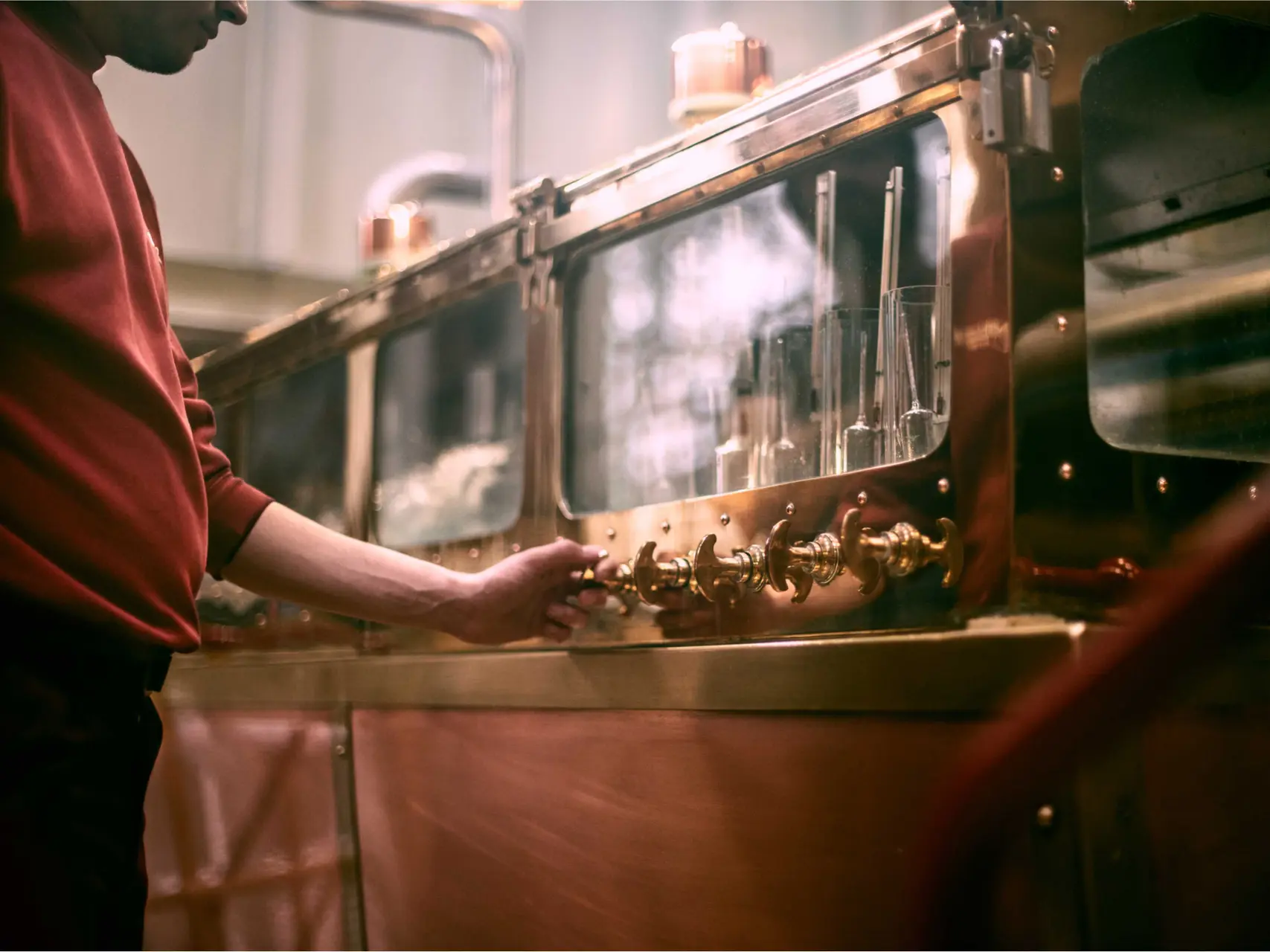
Add Whisky Monkeys as a Google favoriteIf you ever visit a distillery, chances are your eyes go straight to the gleaming copper stills and the long rows of casks. Understandable, they steal the show. But tucked a little further along sits a device that may look less spectacular, yet it decides one of the most important moments in the entire process.
That device is the spirit safe. It’s the glass-and-copper cabinet the spirit flows through while the distiller stands watch beside it. And that act of watching is essential, because this is where the decision is made about what ultimately becomes whisky and what doesn’t.
How to: understand what you’re actually seeing
To truly grasp the spirit safe, you have to let go of one misconception. Whisky doesn’t come ready-made from the still. What runs off is a continuous stream of alcohol that’s constantly shifting in character.
At the start the liquid is sharp and restless. Then it grows softer and purer, before turning heavier and less refined again. That entire evolution unfolds as the liquid passes through the spirit safe.
So the spirit safe isn’t storage, it’s a checkpoint. Inside are glass compartments that make the liquid visible, allowing the distiller to follow exactly what’s happening. They measure the alcohol strength, monitor temperature, and decide what’s usable based on that.
What they cannot do is touch the liquid. And that’s precisely the point of the device.
Why the spirit safe is literally locked
The name “spirit safe” might sound like a neat marketing term, but it’s surprisingly literal. It emerged in an era when the government finally wanted to get a firm grip on whisky production.
With the Excise Act of 1823, distilling became legal, but only under strict conditions. Every drop of alcohol had to be accounted for to make tax evasion impossible.
The solution was a sealed cabinet where the alcohol remained visible but out of reach. Only the excise officer held the key, preventing distillers from diverting anything outside the official process. What began as a control measure has become an essential part of the craft.

A safe with three streams
When you look at the spirit safe, you’re not seeing a single flow of liquid. In reality, that flow is divided into three parts and that’s where things get interesting.
The first portion to arrive is called the foreshots. This is a sharp, volatile liquid that isn’t suitable for making whisky. Next comes the middle cut, the so‑called heart, exactly what the distiller is after. This is the foundation of the final whisky.
Finally, the last portion arrives: the feints. This liquid is heavier and less refined and is usually redistilled.
The tricky part is that these three phases don’t arrive in neat, separate blocks. They blend into one another gradually. There’s no precise instant when one ends and the next begins. And that’s what makes the distiller’s role so important.
The moment of the “cut”
The pivotal moment in the spirit safe is when the distiller decides to switch from one portion to the next. This is known as the “cut.”
That decision isn’t made by a machine, but by experience. The distiller watches the alcohol strength, the temperature, and the behavior of the liquid, but in the end intuition plays a huge role. If the cut is made too early, the whisky loses character and depth. If it’s made too late, unwanted flavors creep into the final product.
That single moment largely shapes how the whisky will taste. Many whisky fans focus on maturation, casks, and age. Those are important factors too, but they all build on what happens earlier in the process.
The choices made in the spirit safe form the backbone of a whisky’s style. Whether a whisky is light and fruity or rich and oily starts here. Everything that follows either amplifies or softens that foundation, but never completely changes it.
From tax control to craftsmanship
Although the spirit safe was originally designed to prevent fraud, today it’s become a symbol of craftsmanship. Modern technology could automate this step, yet many distilleries choose to preserve the traditional method.
Not out of nostalgia, but because it works. Because it compels the distiller to stay hands-on and make choices you can ultimately taste in the glass.
The next time you pour a whisky, you’ll likely think about age, cask, or origin. But long before that whisky reached a bottle, someone stood peering into a glass cabinet and decided the exact moment it was right.
That moment happened in the spirit safe. And without it, your whisky would never taste the same.
loading
POPULAR NEWS

Next year’s exclusive Johnnie Walker whisky is already on sale
You’ll never drink whisky the same way after trying these chocolate pairings
Whisky Names Explained: Octomore
This rare whisky combines Belgian spirit with Japanese craftsmanship

Breaking: English whisky wins historic protection
Ardbeg ends popular whiskyseries with one more bottle
The hidden numbers on your whisky bottle reveal more than you think
World famous Dutch whisky pioneer celebrates 50 years with a mythological whisky series

Whisky gets its own Oktoberfest moment with this special day

Belgian distillery unveils Brussels’ first whisky, but you’ll need to act fast if you want one
LATEST COMMENTS
- Thank you for the compliment. I really appreciate it.M0nkey31-08-2026
- I enjoyed reading the different approaches to building a whisky collection. Whether you collect by region, style, or limited releases, discovering new brands keeps the hobby interesting. Soorahi is another premium whisky worth considering for collectors looking to explore the evolving world of quality whiskies.dinesh04-08-2026
- There is no distillery equipment there and also no licences to produce or sell alcohol.TRC19-12-2025
- Hi Yvonne, Thank you for your response and for sharing the video. Unfortunately, the evidence you referred to consists only of two people talking about the whisky, without any explanation or identification. We have not spoken to the individuals in the video ourselves, nor can we verify who they are. We describe it as a Chinese whisky because it is released by a Chinese distillery. As you mentioned, the distillery has chosen to label the product as “pure malt” instead of “Chinese whisky.” Based on that, we do not believe they are doing anything illegal.M0nkey16-11-2025
- So - you have the proof......where's your write up?Yvonne16-11-2025
- You are absolutely right. Luckily that doesn't matter for the taste of the whisky. Have you tried it yet?M0nkey05-11-2025
- Guess what? Finland is not part of Scandinavia.Gray105-11-2025
- Throw in the towel? You mean restructure to compete and win in a challenging industry environment.WestwardFounder21-10-2025
- There is nothing legally to prevent the English whisky GI from coming into force, it complies with all the relevant laws and the single malt definition follows the precedent of Welsh whisky and US whiskyChefBear15-10-2025
- Three emails sent (two with videos, linked to a Google Drive Share). 1. The original video. 2. The video with subtitles as it was shared on YouTube 3. Screen grab of the YouTube channel where the video was blocked due to Pernod Ricard lobbying. The story was covered on Drinks Intel at the time - link here - https://drinks-intel.com/subscriber-news/pernod-ricards-the-chuan-pure-malt-whisky-not-sourced-solely-from-china-global-drinks-intel-exclusive/Yvonne10-10-2025
Loading