Never miss whisky news, reviews, and new releases again.
Add Whisky Monkeys as a Google favoriteAlongside bourbon and single malt, the United States also produces Tennessee whiskey. What makes this style unique and so distinct from other types of whisk(e)y? We’ll explain.
Pick up a bottle of Jack Daniel’s and, next to the brand name in bold letters, you’ll see the words “Tennessee Whiskey.” That’s not just a label, it tells you exactly what’s inside.
Tennessee whiskey is defined by law
The whiskey in that bottle isn’t just any spirit made in Tennessee, it goes through a distinctive process before it’s bottled. This is called the Lincoln County Process, also known as leaching.
This process sets Tennessee whiskey apart from other American whiskeys, such as bourbon, and it’s even legally required for any whiskey that wants to carry the name “Tennessee.”

What is the Lincoln County Process?
Named after Lincoln County, Tennessee, where it was historically developed, the Lincoln County Process is most famously used by Jack Daniel’s, though other Tennessee whiskey makers use it as well.
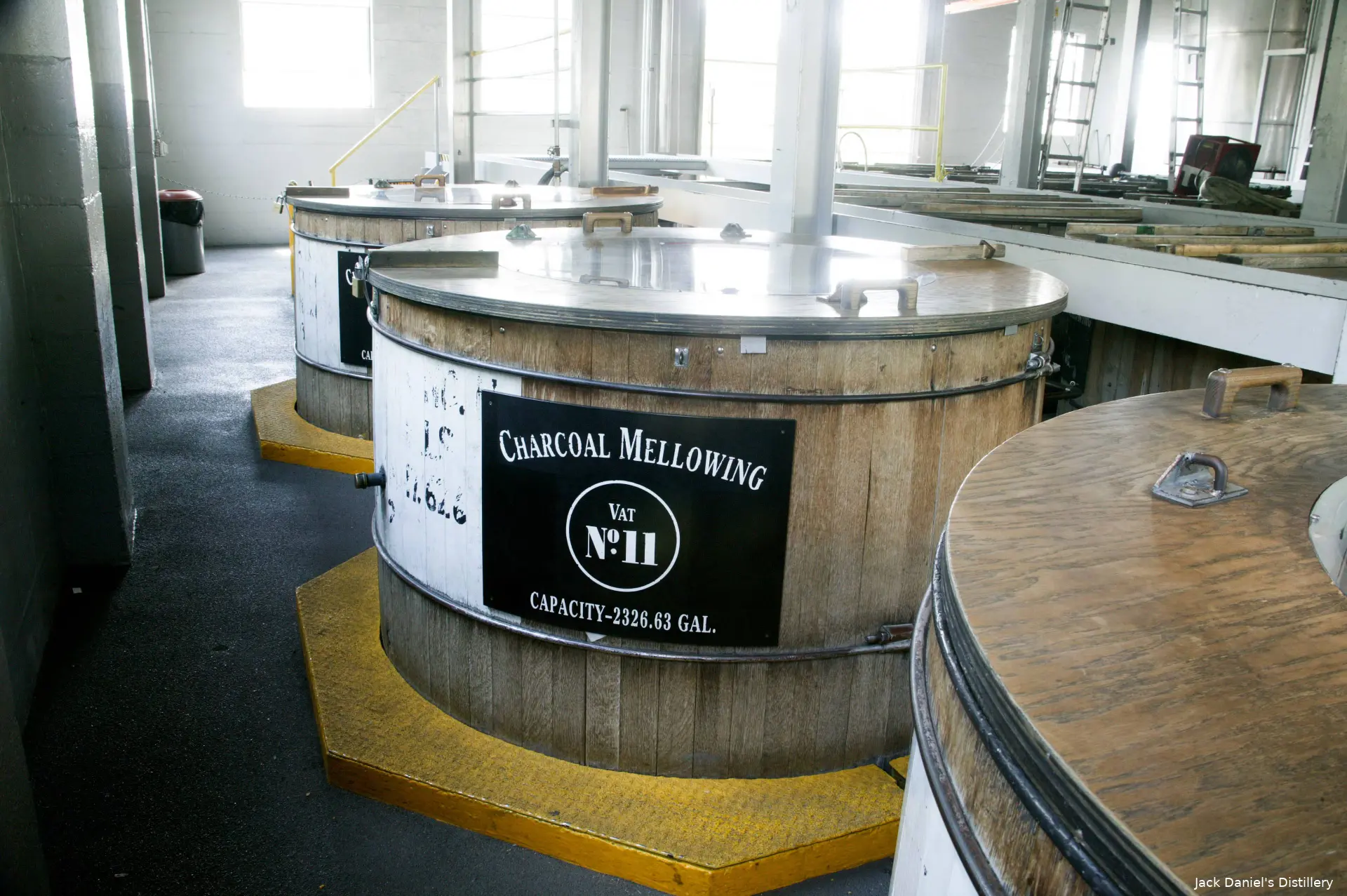
During the Lincoln County Process, the spirit is filtered after distillation (so before aging). It is run through a thick bed of charcoal made from sugar maple wood.
The charcoal is first burned, then cooled and crushed. The whiskey then trickles through this charcoal bed drop by drop. This process can take days.

What does leaching do to whiskey?
The Lincoln County Process removes harsh and bitter compounds from the spirit. At the same time, it imparts a subtle hint of the charcoal’s smoky, slightly sweet character.
The result is a whiskey that, after aging, often feels smoother and more approachable than some other American whiskeys.
During maturation, additional flavors are drawn from the wood: think vanilla, caramel, and tannins.
It’s important to note that this is not the same as cask aging. The filtration happens entirely before the whiskey goes into oak barrels. The aging that follows adds further layers like vanilla, caramel, and wood.
Have you ever tried a Tennessee whiskey? If so, which one?
loading
POPULAR NEWS

The 10 whisky brands connoisseurs admire most

Bowmore's new whisky tastes like charred mango, says the distillery

The best whiskies from all of Speyside: these are the ones to pour this year

You’ll never drink whisky the same way after trying these chocolate pairings
Scottish community distillery sounds the alarm as whisky industry downturn bites

A brand new Ardbeg is coming and the current whiskies are getting a new look

Laphroaig honors its savior with an extraordinarily old and rare whisky
Indian ban forces sudden recipe change for a popular Diageo whisky
This might be the secret behind Indias rapid whisky rise

Whisky Names Explained: Highland Park Dragon Legend
LATEST COMMENTS
- Thank you for the compliment. I really appreciate it.M0nkey31-08-2026
- I enjoyed reading the different approaches to building a whisky collection. Whether you collect by region, style, or limited releases, discovering new brands keeps the hobby interesting. Soorahi is another premium whisky worth considering for collectors looking to explore the evolving world of quality whiskies.dinesh04-08-2026
- There is no distillery equipment there and also no licences to produce or sell alcohol.TRC19-12-2025
- Hi Yvonne, Thank you for your response and for sharing the video. Unfortunately, the evidence you referred to consists only of two people talking about the whisky, without any explanation or identification. We have not spoken to the individuals in the video ourselves, nor can we verify who they are. We describe it as a Chinese whisky because it is released by a Chinese distillery. As you mentioned, the distillery has chosen to label the product as “pure malt” instead of “Chinese whisky.” Based on that, we do not believe they are doing anything illegal.M0nkey16-11-2025
- So - you have the proof......where's your write up?Yvonne16-11-2025
- You are absolutely right. Luckily that doesn't matter for the taste of the whisky. Have you tried it yet?M0nkey05-11-2025
- Guess what? Finland is not part of Scandinavia.Gray105-11-2025
- Throw in the towel? You mean restructure to compete and win in a challenging industry environment.WestwardFounder21-10-2025
- There is nothing legally to prevent the English whisky GI from coming into force, it complies with all the relevant laws and the single malt definition follows the precedent of Welsh whisky and US whiskyChefBear15-10-2025
- Three emails sent (two with videos, linked to a Google Drive Share). 1. The original video. 2. The video with subtitles as it was shared on YouTube 3. Screen grab of the YouTube channel where the video was blocked due to Pernod Ricard lobbying. The story was covered on Drinks Intel at the time - link here - https://drinks-intel.com/subscriber-news/pernod-ricards-the-chuan-pure-malt-whisky-not-sourced-solely-from-china-global-drinks-intel-exclusive/Yvonne10-10-2025
Loading