Whisky Names Explained: 100 Proof, the British vs. American system
SectionsMonday, 10 August 2026 at 14:21
Never miss whisky news, reviews, and new releases again.
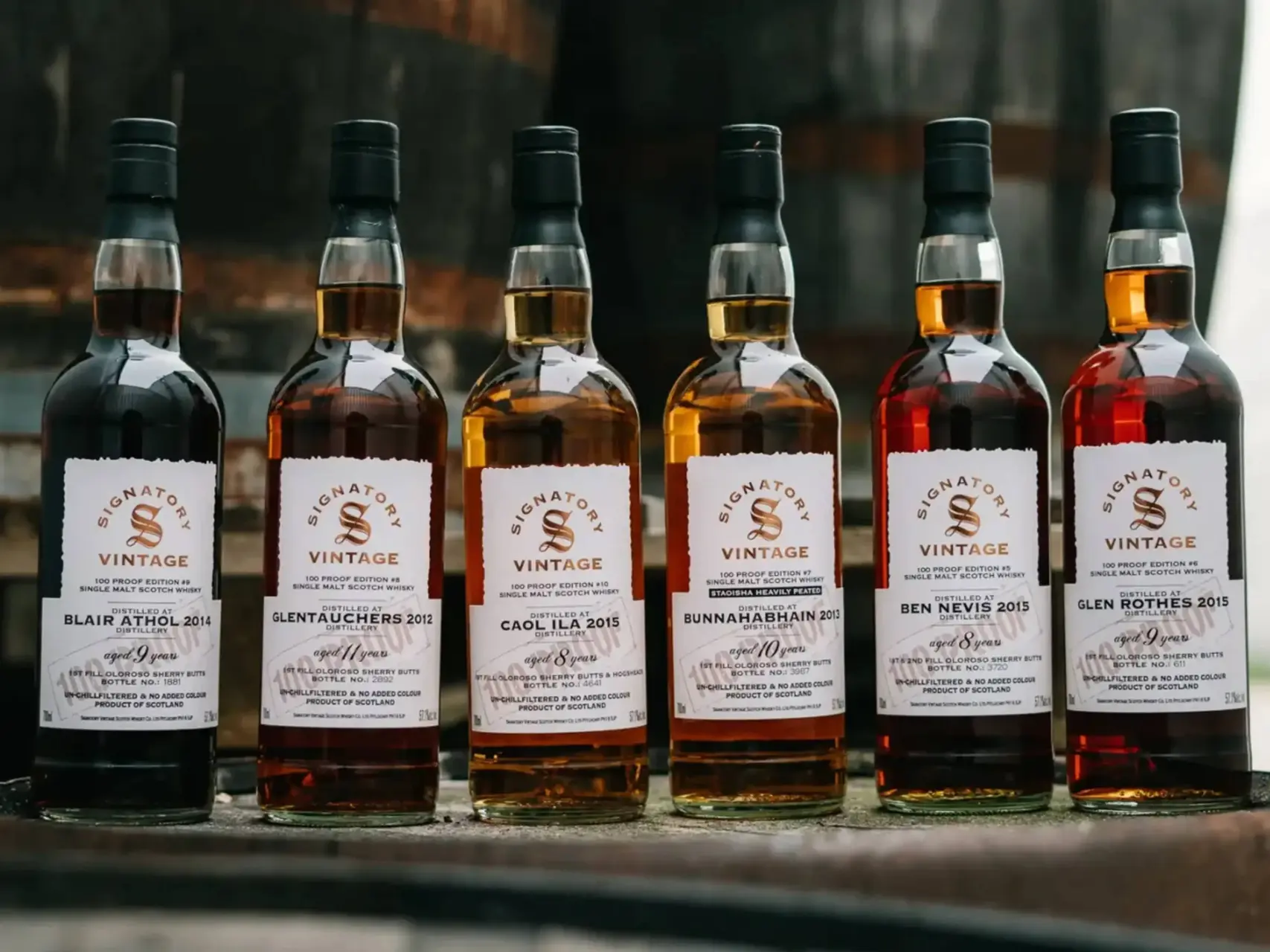
Add Whisky Monkeys as a Google favoriteAnyone holding a bottle of Signatory Vintage 100 Proof might assume it’s a whisky at 50 percent alcohol by volume. Not so. In the Signatory Vintage series, every whisky is bottled at 57.1 percent ABV. The reason lies in the difference between the British and American proof systems. You can read how that works in this Whisky Names Explained.
Let’s start at the beginning: what does the word proof actually mean? In English, proof means evidence. When we’re talking about spirits like whisky, it essentially means proof of strength. Back before modern equipment existed to measure alcohol, a distillery could “prove” the alcohol content another way.
Read also
The British proof system
In the United Kingdom, proving alcohol took a rather unusual form. The spirit was mixed with gunpowder and then ignited. If the liquid wouldn’t burn, it was “under proof.” If the gunpowder blend did catch fire, the spirit was “proof.”
In 1816, Bartholomew Sikes invented the hydrometer, making it much easier to determine a whisky’s alcohol content. The proof threshold established by the gunpowder test later averaged out at 57.1 percent alcohol by volume (ABV). By then, the proof system was firmly ingrained, so 57.1 percent ABV became 100 proof. The United Kingdom didn’t switch to expressing alcohol content in ABV until 1980.
| Whisky Deals from Whisky Exchange | Week 33 |
| Glen Moray Forbidden Fruit | 29,58 pounds |
| Mortlach 2003 21 year old bourbon cask signatory | 158,33 pounds (save 55 pounds) |
| Redbreast 18 year old | 112,50 pounds (save 40 pounds) |
| Red Sport 1991 31 year old Marsala cask | 537,50 pounds (save 300 pounds) |
| Suntory Tsukuriwake Cask Collection 2024 | 2395,83 pounds (save 800 pounds) |
The American proof system
Now that we know the British proof system was based on a gunpowder test, let’s look at the American system. In the United States, “US proof” was adopted as a way to express a spirit’s strength. ABV had been the international standard for years, but Americans like to do things their own way. US proof began appearing alongside ABV more and more on bottles of bourbon and American whiskey.
Much like the Bottled in Bond tradition, read more in our article on proof - US proof gradually became a mark of prestige for American whiskey and bourbon, often at higher strengths. US proof isn’t determined by an old-fashioned gunpowder test. It’s simply a bit of math: take the ABV and multiply by two. A whisky at 46 percent becomes 92 proof, and 100 proof corresponds to 50 percent ABV.
FAQ
- What does 100 proof mean in whisky?
That depends on the proof system used. In the old British system, 100 proof equals 57.1% ABV, while in the American system, 100 proof equals 50% ABV. - Why is Signatory Vintage 100 Proof 57.1%
ABV? Signatory Vintage uses 100 proof in reference to the historical British proof system, in which 57.1% alcohol by volume was considered 100 proof. - How do you convert US proof to ABV?
In the American system, proof is simply twice the alcohol percentage. So a whisky at 46% ABV is 92 proof, and a whisky at 50% ABV is 100 proof.
loading
POPULAR NEWS
Next year’s exclusive Johnnie Walker whisky is already on sale
The 10 whisky brands connoisseurs admire most
You’ll never drink whisky the same way after trying these chocolate pairings
Scottish community distillery sounds the alarm as whisky industry downturn bites
UK government shuts down whisky company over the sale of non-existent casks
Laphroaig honors its savior with an extraordinarily old and rare whisky
This rare whisky combines Belgian spirit with Japanese craftsmanship
Breaking: English whisky wins historic protection
Why Bruichladdich’s Master Blender Wants Islay in Every Drop of Whisky
Ardbeg ends popular whiskyseries with one more bottle
LATEST COMMENTS
- Thank you for the compliment. I really appreciate it.M0nkey31-08-2026
- I enjoyed reading the different approaches to building a whisky collection. Whether you collect by region, style, or limited releases, discovering new brands keeps the hobby interesting. Soorahi is another premium whisky worth considering for collectors looking to explore the evolving world of quality whiskies.dinesh04-08-2026
- There is no distillery equipment there and also no licences to produce or sell alcohol.TRC19-12-2025
- Hi Yvonne, Thank you for your response and for sharing the video. Unfortunately, the evidence you referred to consists only of two people talking about the whisky, without any explanation or identification. We have not spoken to the individuals in the video ourselves, nor can we verify who they are. We describe it as a Chinese whisky because it is released by a Chinese distillery. As you mentioned, the distillery has chosen to label the product as “pure malt” instead of “Chinese whisky.” Based on that, we do not believe they are doing anything illegal.M0nkey16-11-2025
- So - you have the proof......where's your write up?Yvonne16-11-2025
- You are absolutely right. Luckily that doesn't matter for the taste of the whisky. Have you tried it yet?M0nkey05-11-2025
- Guess what? Finland is not part of Scandinavia.Gray105-11-2025
- Throw in the towel? You mean restructure to compete and win in a challenging industry environment.WestwardFounder21-10-2025
- There is nothing legally to prevent the English whisky GI from coming into force, it complies with all the relevant laws and the single malt definition follows the precedent of Welsh whisky and US whiskyChefBear15-10-2025
- Three emails sent (two with videos, linked to a Google Drive Share). 1. The original video. 2. The video with subtitles as it was shared on YouTube 3. Screen grab of the YouTube channel where the video was blocked due to Pernod Ricard lobbying. The story was covered on Drinks Intel at the time - link here - https://drinks-intel.com/subscriber-news/pernod-ricards-the-chuan-pure-malt-whisky-not-sourced-solely-from-china-global-drinks-intel-exclusive/Yvonne10-10-2025
Loading