Never miss whisky news, reviews, and new releases again.
Add Whisky Monkeys as a Google favoriteWhen you think of single malt whisky, Scotland, Ireland or Japan probably spring to mind. But some excellent whisky is being made on the other side of the world, too. In Melbourne, Australia, there’s a distillery that takes a slightly different approach to whisky-making. Think local ingredients, Australian wine casks and a climate that can be wildly unpredictable. We’re talking, of course, about Starward.
The distillery is only 20 years old, but it has already built an impressive reputation around the world. What began as an ambitious plan by whisky enthusiast David Vitale quickly grew into a well-known and much-loved whisky brand.
A whisky dream in an old aircraft hangar
To trace the story of Starward, we go back to 2007. That was when David Vitale decided the time had come for a whisky with a truly Australian character. Vitale grew up in an Italian family in Melbourne, where good food and gathering around the table were a big part of life. He was also a passionate craft beer enthusiast.
Vitale’s love of the water of life began when he discovered just how much beer and single malt whisky have in common. His interest in distilling grew, and he came up with the idea of making a whisky that reflected Melbourne’s food culture.
Rather than looking to Scotland, he found inspiration much closer to home. After all, Australia had already earned an excellent reputation for its wine. So why not whisky?
Vitale found a home for his plans in a former Qantas aircraft hangar at Essendon Fields, near Melbourne. It wasn’t an ancient building steeped in history, but an old hangar where he could work on his whisky dream. This was where Starward’s foundations were laid.

A gamble on Australian wine casks
As he developed his whisky, Vitale faced an important choice. He could play it safe and use traditional bourbon casks, as many other distilleries did. Instead, he decided to try something different.
Starward’s first whisky, Solera, was matured in casks that had previously held Australian Apera, a fortified wine similar to sherry. The casks brought rich notes of dried fruit and sweetness, but Vitale was keen to explore further.
His attention turned to Australia’s wine industry. The red wines from around Melbourne, in particular, offered exciting possibilities. So he decided to mature his whisky in freshly emptied red wine casks.
At the time, it was quite a gamble. No one knew exactly how the young whisky would develop in these casks. The wine might overpower it, or the wood might simply clash with the spirit. And making whisky takes a great deal of time and money, so a failed maturation would have been a serious setback. Vitale went ahead regardless—and it paid off. Those Australian red wine casks became Starward’s signature.

Four seasons in one day
It’s not just the wine casks that set Starward apart from many traditional whisky distilleries. Melbourne’s climate also plays an important role.
The Australian city is known for its changeable weather. One moment the sun can be shining brightly; the next, the temperature can drop sharply. Melbourne is often described as a city where you can experience four seasons in one day.
Those temperature swings make for interesting whisky maturation. As the weather shifts between warm and cold, the cask wood expands and contracts. This brings the whisky into close contact with the wood time and again, drawing out the cask’s flavours and aromas.
Starward makes deliberate use of this. The distillery works with Australian grains and sources much of its raw materials locally. Its wine casks also come from producers about a day’s drive from Melbourne.
After being emptied, the casks are brought to the distillery as quickly as possible, preserving as much of the original wine’s influence as they can. Casks that once held shiraz and cabernet sauvignon are especially important to Starward’s distinctive, fruit-forward style.

From Essendon Fields to Port Melbourne
The old aircraft hangar was a great place to start, but as Starward grew, it needed a bigger home.
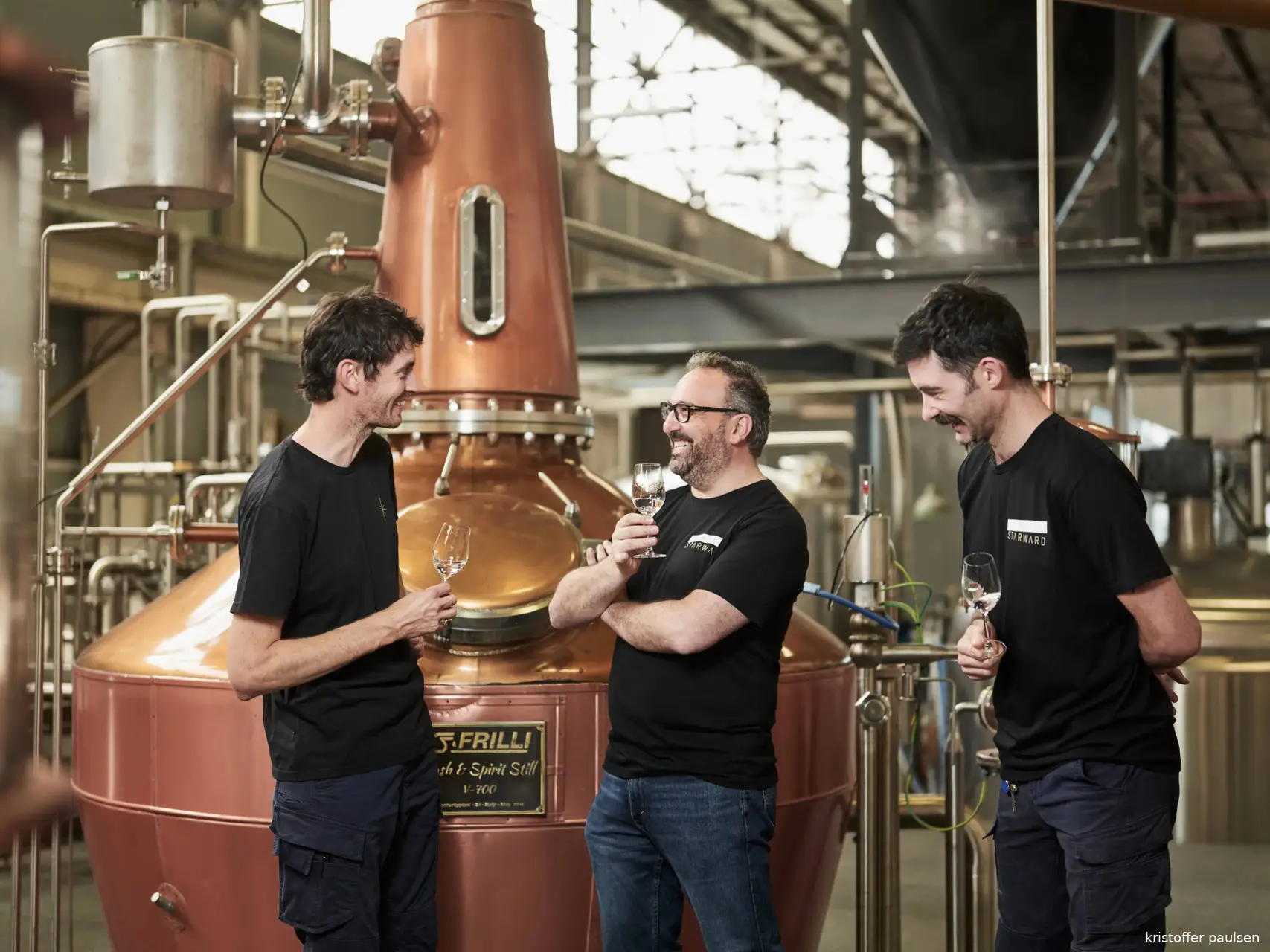
The distillery therefore moved to Port Melbourne, where it had more room to produce and further develop its whiskies. It also invested in modern equipment designed to use water, gas and electricity more efficiently.
One thing that stands out about Starward is that its team isn’t made up solely of people with backgrounds in whisky. Former brewers and winemakers are part of the team, too. Those varied backgrounds fit perfectly with the distillery’s approach.
Although Starward uses well-established whisky-making techniques, the distillery isn’t afraid to experiment with new ideas. At one point, it even brewed its own ginger beer, then aged whisky in the casks it had used.

From Solera to Nova: Starward’s whiskies
Starward has now released several whiskies. Its very first was Solera, a single malt aged in Australian Apera casks. Rich in character, it offers notes of dried fruit, sweetness and spice.
Another well-known whisky is Starward Nova. It’s made using Australian red wine casks, including those that previously held Shiraz, Cabernet Sauvignon and Pinot Noir. The result is a fruity whisky with notes of red berries, spice and oak.
Starward Left-Field is another familiar name in the range. This single malt was created with European whisky drinkers among others in mind and is aged entirely in French oak red wine casks. For those who like a little more punch in their glass, there’s Starward 100 Proof: a 50% ABV whisky with a fuller character.
The distillery also regularly experiments with unusual cask finishes. One whisky, for example, spent 18 months in casks that had previously held peated whisky after first maturing in red wine casks. The result gave Starward’s signature fruity style a smoky edge.
An Australian distillery winning international acclaim
Starward’s distinctive approach made quite an impression in 2022. At the San Francisco World Spirits Competition, the distillery was named Most Awarded Distillery of the Year—a remarkable achievement for a whisky brand founded just 15 years earlier.
That same year, Starward marked its 15th anniversary with Vitalis, a special whisky blended from six different parcels, each representing a chapter in the distillery’s history. Its name pays tribute to founder David Vitale.
The Australian brand is also attracting more attention in the Netherlands. Since 1 October 2026, De Monnik Dranken has been distributing Starward in the country, making the whiskies from Melbourne more accessible to Dutch whisky lovers.

Starward continues to forge its own path
What began in 2007 with an idea and an old aircraft hangar has grown into a distillery known around the world for its whiskies aged in Australian wine casks. And although Starward is still relatively young, the brand has already built quite a story in a short time.
A blend of local ingredients, Melbourne’s changeable climate and the influence of red wine casks gives the whiskies their distinctive character. All the while, the distillery continues to experiment with new flavours and unusual casks.
So if you’re in the mood to try something beyond the familiar Scottish single malts, Starward is well worth exploring. You might discover that Australia has more to offer in the world of whisky than you’d expect.
Have you tried a Starward whisky? Let us know in the comments below.
Made possible by De Monnik Dranken.
loading
POPULAR NEWS
Bowmore Brings Back a Devilish Whisky After More Than 10 Years (and Two Old Casks Take Center Stage)
Yamazaki’s New Japanese whisky reveals a surprising side of Spanish oak casks
Belgian Distillery Gone: Old Caperdonich Stills Up for Auction
5 Indian whiskies that taste like liquid gold
These 5 Japanese Whiskies Have Been Crowned Liquid Gold (And You Won’t Know Every Name)

Did you know India’s most popular whisky often has a Scottish secret?
From Amrut to Indri: These Indian Whiskies Are Turning Heads in 2026
Scotland Fears for the Future of Single Malt Whisky: Here’s Why

Turntable Just Did Something Unusual With three New Scotch Whiskies

Hazelburn whisky's historic name hides details that might surprise the whisky lover
LATEST COMMENTS
- Thank you for the compliment. I really appreciate it.M0nkey31-08-2026
- I enjoyed reading the different approaches to building a whisky collection. Whether you collect by region, style, or limited releases, discovering new brands keeps the hobby interesting. Soorahi is another premium whisky worth considering for collectors looking to explore the evolving world of quality whiskies.dinesh04-08-2026
- There is no distillery equipment there and also no licences to produce or sell alcohol.TRC19-12-2025
- Hi Yvonne, Thank you for your response and for sharing the video. Unfortunately, the evidence you referred to consists only of two people talking about the whisky, without any explanation or identification. We have not spoken to the individuals in the video ourselves, nor can we verify who they are. We describe it as a Chinese whisky because it is released by a Chinese distillery. As you mentioned, the distillery has chosen to label the product as “pure malt” instead of “Chinese whisky.” Based on that, we do not believe they are doing anything illegal.M0nkey16-11-2025
- So - you have the proof......where's your write up?Yvonne16-11-2025
- You are absolutely right. Luckily that doesn't matter for the taste of the whisky. Have you tried it yet?M0nkey05-11-2025
- Guess what? Finland is not part of Scandinavia.Gray105-11-2025
- Throw in the towel? You mean restructure to compete and win in a challenging industry environment.WestwardFounder21-10-2025
- There is nothing legally to prevent the English whisky GI from coming into force, it complies with all the relevant laws and the single malt definition follows the precedent of Welsh whisky and US whiskyChefBear15-10-2025
- Three emails sent (two with videos, linked to a Google Drive Share). 1. The original video. 2. The video with subtitles as it was shared on YouTube 3. Screen grab of the YouTube channel where the video was blocked due to Pernod Ricard lobbying. The story was covered on Drinks Intel at the time - link here - https://drinks-intel.com/subscriber-news/pernod-ricards-the-chuan-pure-malt-whisky-not-sourced-solely-from-china-global-drinks-intel-exclusive/Yvonne10-10-2025